
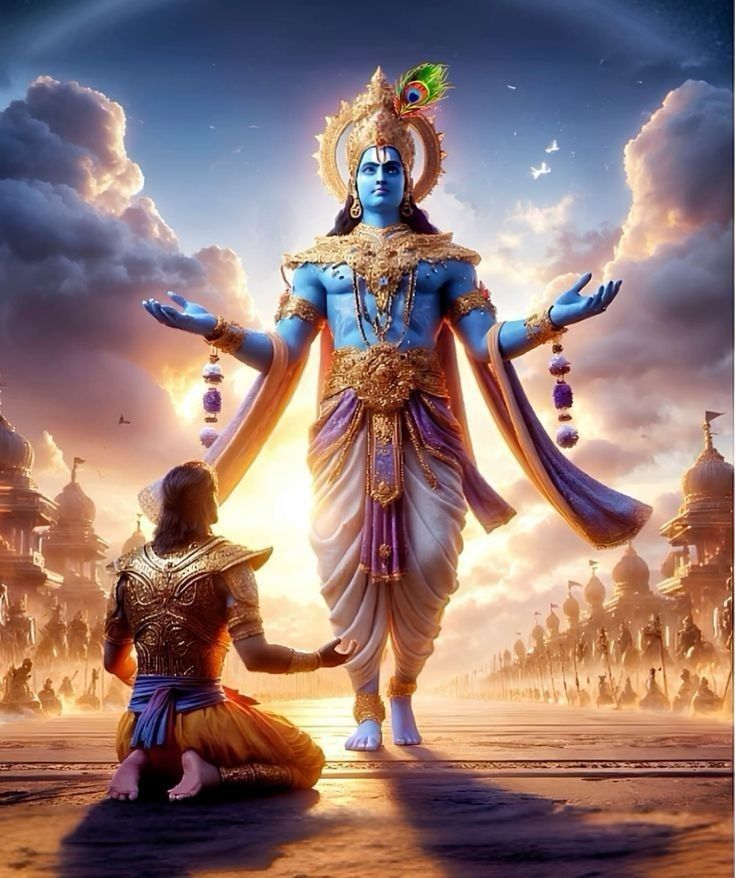
Light from the Gita, guidance for the soul.
The Bhagavad Gita is not just an ancient scripture—it is a timeless guide to life, clarity, and inner strength. Every verse carries a jewel of wisdom, showing us how to rise above confusion, balance action with peace, and discover the divine within. In this section, we unfold those eternal teachings in simple words, blending their spiritual depth with practical lessons for everyday life. Let these insights be your compass—helping you walk through challenges with courage, calmness, and clarity.
Insights from the Bhagavad Gita: Finding Balance in Daily Life
1. Act Without Attachment (Karma Yoga)
Sloka:
कर्मण्येवाधिकारस्ते मा फलेषु कदाचन।
मा कर्मफलहेतुर्भूर्मा ते सङ्गोऽस्त्वकर्मणि॥
(Bhagavad Gita 2.47)
The Verse (Translation)
“You have a right to perform your prescribed duties, but you are not entitled to the fruits of your actions. Do not consider yourself the cause of the results, and do not be attached to inaction.”
Context
Arjuna, caught in despair, wishes to abandon his duty as a warrior. Shri Krishna, as his charioteer and guide, reminds him of a profound truth: We are free to act, but the results are not in our control. Action is our domain, outcome belongs to the Divine.
Word-by-Word Meaning
- कर्मणि एव अधिकारः ते (Karmaṇi Eva Adhikāraḥ Te) – Your right is only in action, in performing duty.
- मा फलेषु कदाचन (Mā Phaleṣu Kadācana) – Never in the fruits or outcomes of action.
- मा कर्मफलहेतुर्भूः (Mā Karma-Phala-Hetuḥ Bhūḥ) – Do not think yourself the cause of results; they arise from many factors.
- मा ते सङ्गः अस्तु अकर्मणि (Mā Te Saṅgaḥ Astu Akarmaṇi) – Do not become attached to inaction; don’t fall into laziness by renouncing work.
Expanded Explanation
This sloka is the foundation of Karma Yoga. Krishna teaches:
- Your right is in action, not results – We can control our efforts, but never the outcome. Results are shaped by time, destiny, and Divine will.
- Don’t become egoistic – Thinking “I alone achieved this” is ignorance. Every result is a combination of effort, grace, and cosmic order.
- Don’t escape from duty – Renouncing action out of fear of failure or greed for success is wrong. Inaction is against dharma.
- Balanced living – Work sincerely, surrender results, stay free of anxiety.
Practical Insight for Today
- At work: Do your job with excellence, but don’t tie your happiness to promotions or recognition.
- In business: Focus on quality and integrity, instead of being obsessed with profit alone.
- In personal growth: Practice, learn, and improve daily — leave the results to time and effort combined.
- In life: Results are uncertain, but peace in action is always certain when done with detachment.
Essence
This verse liberates us from the bondage of expectation.
True freedom is not in escaping work, but in working without anxiety and ego.
“Do your best, surrender the rest.”
Would you like me to write a combined blog post that connects 2.47 and 2.48 together (since they are complementary — duty without attachment + balance in success/failure) for a more holistic Bhagavad Gita Insight article?
Expanded Insight:
- Krishna teaches Arjuna the value of performing one’s duty wholeheartedly, without getting attached to success or failure.
- Detachment from results doesn’t mean apathy, but living with a calm mind, accepting whatever comes as prasad (divine gift).
- Action Point: Before big decisions (work, relationships), recite this sloka to remind yourself to focus on effort and let go of anxiety about outcomes.
2. Equanimity in All Situations (Samatvam Yoga)
Sloka:
योगस्थः कुरु कर्माणि सङ्गं त्यक्त्वा धनञ्जय।
सिद्ध्यसिद्ध्योः समो भूत्वा समत्वं योग उच्यते॥
(Bhagavad Gita 2.48)
The Verse (Translation)
“O Dhananjaya (Arjuna), perform your duties being steadfast in Yoga, abandoning attachment, and remaining balanced in success and failure. Such equanimity is called Yoga.”
Context
In this chapter, Arjuna is torn between duty (dharma) and emotion. Confused on the battlefield of Kurukshetra, he feels paralyzed, not wanting to fight against his own relatives and teachers.
Shri Krishna gently guides him towards the essence of Karma Yoga: Do your duty, but without attachment to the result.
Word-by-Word Meaning
- योगस्थः (Yogasthaḥ) – Established in Yoga; rooted in discipline, balance, and union with the Divine.
- कुरु कर्माणि (Kuru Karmāṇi) – Perform your actions; fulfill your duties.
- सङ्गं त्यक्त्वा (Saṅgaṃ Tyaktvā) – Abandon attachment; don’t cling to outcomes or rewards.
- धनञ्जय (Dhanañjaya) – Arjuna’s name, “the conqueror of wealth”; here, Krishna lovingly addresses him.
- सिद्ध्यसिद्ध्योः समः भूत्वा (Siddhy-Asiddhyoḥ Samaḥ Bhūtvā) – Treat success and failure equally, with calmness.
- समत्वं योग उच्यते (Samatvaṃ Yoga Ucyate) – This evenness of mind, this equanimity, is true Yoga.
Expanded Explanation
Krishna tells Arjuna that Yoga is not escape, but balance. To live in Yoga means:
- Perform your duty (Karma) faithfully – Whatever life assigns you, do it with sincerity and dedication.
- Renounce attachment to results – Success and failure, praise and blame, gain and loss — all are temporary.
- Stay balanced in dualities – Neither celebrate excessively in success, nor drown in despair during failure.
- Equanimity is Yoga – True spiritual maturity lies in this calm, steady state of mind.
Just as a lotus remains untouched by water, the yogi remains untouched by external fluctuations while fully engaged in life.
Practical Insight for Today
- At work: Focus on doing your best, instead of worrying constantly about promotion or appreciation.
- In relationships: Love and serve selflessly, without calculating what you’ll get in return.
- In challenges: Accept outcomes gracefully, understanding that effort is in your hands, but results are governed by a higher order.
This verse frees us from the anxiety of results and brings peace in action.
Expanded Insight:
- Equanimity—staying calm and balanced in joy and sorrow—is the heart of Yoga.
- This mental steadiness helps you handle difficult times, criticism, and change without emotional swings.
- Action Point: When facing adversity or praise, meditate on this sloka and practice being a silent witness to your feelings.
3. Power of Mind Control
Sloka:
असंशयं महाबाहो मनो दुर्निग्रहं चलम्।
अभ्यासेन तु कौन्तेय वैराग्येण च गृह्यते॥
(Bhagavad Gita 6.35)
यह श्लोक भगवद्गीता अध्याय 6, श्लोक 35 का है। इसमें भगवान श्रीकृष्ण अर्जुन से मन के नियंत्रण के बारे में बताते हैं।
Translation
“O mighty-armed Arjuna, undoubtedly the mind is restless and difficult to control. But, O son of Kunti, it can be subdued by constant practice and detachment.”
Expanded Explanation
In this verse, Lord Krishna gently acknowledges Arjuna’s concern about the restless nature of the mind. Arjuna has just confessed that controlling the mind feels as difficult as controlling the wind. Krishna agrees—it is indeed difficult, but not impossible.
1. Restless and Unsteady Mind
The mind, by its very nature, is like a monkey—jumping from one thought to another, rarely still. It runs toward desires, worries, and memories, and resists discipline. 2. Acceptance of Difficulty
Krishna does not dismiss Arjuna’s fear. Instead, He validates it. By saying “Undoubtedly,” He acknowledges the universal human struggle with the mind. This makes the teaching compassionate and relatable. 3. The Two Keys – Practice and Detachment
Abhyāsa (Practice):
Repeated effort, whether it is meditation, prayer, chanting, or mindful living, helps tame the wandering mind. Just as a river carves valleys over centuries, consistent practice shapes the mind toward steadiness.
Vairāgya (Detachment):
Freedom from attachments and cravings reduces the turbulence of the mind. When we are less entangled with worldly outcomes, the mind becomes lighter and easier to guide. Detachment here does not mean rejection of life, but rather cultivating inner balance amidst life’s ups and downs. 4. The Balance of Both
Practice without detachment may lead to frustration, while detachment without practice may lead to inertia. Together, they create harmony—discipline to guide the mind and wisdom to release its restless grip.
Life Lesson
Krishna’s words remind us: Yes, the mind is restless, but it is not unconquerable. With steady effort and inner renunciation, we can rise above mental chaos and experience peace.
This verse gives hope to every seeker—that inner mastery is not reserved for saints or sages alone, but is achievable for anyone who walks the path sincerely.
In your own life, whenever your mind feels uncontrollable, remember: it can be guided gently with patient practice and freedom from clinging. This is the essence of yoga.
Expanded Insight:
- The mind is restless, but it can be tamed through regular practice (abhyasa) and detachment (vairagya).
- Techniques such as meditation, breath control, and mindful observation help master thoughts and impulses.
- Action Point: Dedicate daily time for meditation, using this sloka as a mantra for focus and inner discipline.
4. Importance of Self-Realization
Sloka:
न जायते म्रियते वा कदाचिन्नायं भूत्वा भविता वा न भूयः।
अजो नित्यः शाश्वतोऽयं पुराणो न हन्यते हन्यमाने शरीरे॥
(Bhagavad Gita 2.20)
Expanded Insight:
- The Gita’s core message is recognizing the eternal nature of the soul, which is never born nor dies, but only passes through bodies.
- This insight dissolves fear and confusion over change, ageing, and loss.
- Action Point: Contemplate your true self beyond name, form, and roles—use this verse in daily prayer to connect with inner peace.
Word-by-Word Meaning
- na jāyate – never born
- mriyate vā kadācin – nor ever dies
- nāyaṁ bhūtvā bhavitā vā na bhūyaḥ – having once come into existence, it never ceases to be
- ajaḥ – unborn
- nityaḥ – eternal
- śāśvataḥ – everlasting, permanent
- ayaṁ purāṇaḥ – this (soul) is ancient, primeval
- na hanyate hanyamāne śarīre – it is not destroyed when the body is destroyed
Central Meaning
The soul is never born, nor does it ever die. It has never come into being at some point, nor will it ever cease to exist. The soul is unborn, eternal, everlasting, and primeval. When the body is slain, the soul is not slain.
Expanded Explanation
- The soul is beyond birth and death
What we call “birth” and “death” are events of the body, not of the soul. The soul merely enters a body and leaves it, just like a person changes clothes. - Continuity of existence
The soul has no beginning or end. It never passes from “non-existence” to “existence.” It simply is—always present, beyond the cycles of creation and destruction. - Unborn and Eternal
Unlike the body, which takes form and perishes, the soul is unborn—without origin. Being eternal, it is not subject to time. - Everlasting and Ancient
The soul is “purāṇa”—ancient, timeless. It was there before creation and will remain after dissolution. No material changes can touch it. - Body dies, but the soul doesn’t
Death is only the destruction of the physical body. The soul, untouched, continues its journey, moving to another body according to karma.
Philosophical Insight
- This verse establishes the immortality of the soul (ātman) as distinct from the body.
- It removes the fear of death, showing death as a natural transition, not an end.
- Krishna gave this teaching to Arjuna to free him from grief and confusion in battle.
Practical Message for Us
- Fearlessness of death – Realizing the soul is immortal helps us overcome fear and attachment.
- Detachment and balance – Gains and losses belong to the body and mind, but the soul remains unchanged.
- Duty without hesitation – Knowing the eternal nature of the soul, one can perform one’s duty (like Arjuna in the battlefield) without being paralyzed by fear or sorrow.
- Purpose of life – The true aim of human life is to realize the soul and its eternal connection with the Divine.
In simple terms:
We are not the body; we are the soul. The body dies, but the soul never dies. Death is only a change of garment for the soul.
5. Embrace Righteous Action (Dharma)
Sloka:
श्रेयान्स्वधर्मो विगुणः परधर्मात्स्वनुष्ठितात्।
स्वभावनियतं कर्म कुर्वन्नाप्नोति किल्बिषम्॥
(Bhagavad Gita 18.47)
Expanded Insight:
- Krishna highlights the need to follow one’s own dharma—even imperfectly—rather than another’s, aligning actions with true nature.
- Acting according to dharma brings satisfaction, reduces inner conflict, and fosters harmony.
- Action Point: Reflect on your personal strengths and responsibilities; read this sloka in moments of doubt or moral dilemma.
Word-by-Word Meaning
- śreyān – better, superior
- sva-dharmaḥ – one’s own prescribed duty
- viguṇaḥ – though imperfectly performed, even with shortcomings
- para-dharmāt – than another’s duty
- su-anuṣṭhitāt – perfectly performed
- svabhāva-niyatam karma – duty born of one’s own nature (inherent qualities)
- kurvan – by performing
- na āpnoti kilbiṣam – one does not incur sin
Central Meaning
It is better to perform one’s own duty (svadharma), even if imperfectly, than to perform another’s duty (paradharma) perfectly. By following the work determined by one’s own nature, one does not incur sin.
Expanded Explanation
- Svadharma vs Paradharma
- Svadharma: The duty or responsibility that naturally belongs to a person based on their nature, abilities, and position in life.
- Paradharma: The duty of another person, which may look attractive but does not truly align with one’s inner nature.
- Why Svadharma is Superior
Each soul is born with certain tendencies (svabhāva) shaped by past karmas. When we act according to this nature, our actions are harmonious, natural, and sustainable. Acting against one’s nature leads to inner conflict and bondage. - Imperfect performance is acceptable
Even if we fail or are clumsy in our own duties, it is still spiritually uplifting. A borrowed duty, even if done perfectly, leads to disharmony and spiritual stagnation. - No sin in natural duty
Duties aligned with one’s nature (svabhāva-niyatam karma) do not bind one to sin. On the other hand, imitating someone else’s path can create karmic entanglements.
Philosophical Perspective
- This verse reflects the law of dharma—each being has a unique role in the cosmic order.
- Following svadharma is also a form of surrender to divine will, since our nature is given by God.
- It reminds us that spiritual progress is not about copying others but realizing our own true potential.
Practical Message for Us
- Authenticity over imitation – We should focus on our natural strengths and responsibilities instead of comparing ourselves to others.
- Career & life choices – A profession or path that aligns with our nature may not make us richest or most famous, but it will give true fulfillment.
- Inner peace – Acting in harmony with our true self removes guilt and inner conflict.
- Spiritual discipline – Even small, sincere steps on one’s own path are greater than perfect imitation of another’s path.
👉 In simple words:
“It is better to live your own path imperfectly, than to live someone else’s life perfectly. By following the duty born of your nature, you remain free from sin.”
6. Surrender to the Divine
Sloka:
सर्वधर्मान् परित्यज्य मामेकं शरणं व्रज।
अहं त्वां सर्वपापेभ्यो मोक्षयिष्यामि मा शुचः॥
(Bhagavad Gita 18.66)
Expanded Insight:
Action Point: In moments of anxiety, recite this sloka and consciously surrender problems to God, trusting in His grace. Surrendering ego, worries, and all forms of fear to the Divine opens the path to true peace and libera. This practice is not passive; it’s an active offering of every struggle, thought, and deed to a higher will.
Word-by-Word Meaning
- sarva-dharmān parityajya – abandoning all varieties of dharmas (duties, paths, religious obligations)
- mām ekam śaraṇam vraja – take refuge in Me alone, surrender completely to Me
- aham tvām – I (Krishna) will
- sarva-pāpebhyaḥ mokṣayiṣyāmi – deliver you from all sins (past, present, future)
- mā śucah – do not grieve, do not fear
Central Meaning
“Abandon all forms of duties and surrender completely to Me alone. I shall liberate you from all sinful reactions; do not fear.”
Expanded Explanation
- Supreme Call of Grace
This verse is the climax of the Gita. After teaching about karma (action), jñāna (knowledge), and bhakti (devotion), Krishna reveals the essence: total surrender to God. - Sarva-dharmān parityajya
Here, dharma does not only mean religion but all duties, obligations, rituals, philosophies, and even the pride of righteousness. Krishna asks us to give up the idea that we are the doers or saviors of ourselves. - Mām ekam śaraṇam vraja
Krishna is the one ultimate refuge. Not many gods, not different paths, not divided loyalties—surrender to the One Divine Reality alone. This surrender is not weakness, but supreme strength, because it connects us to the eternal source. - Divine Assurance
“I will deliver you.” Liberation is not through our effort alone; it is by God’s grace. This is unconditional assurance that no matter our past sins, surrender brings freedom. - Mā śucah – Fear not
The final words remove all anxiety. The Lord is telling us: “Do not be afraid. Leave everything to Me. I will take care.”
Philosophical Perspective
- Jnana-yoga, Karma-yoga, and Bhakti-yoga culminate here. While duties and disciplines are important, ultimate liberation comes only through surrender (śaraṇāgati).
- This verse is the foundation of Bhakti Vedanta philosophy, teaching that love and surrender to God surpass all intellectual or ritualistic practices.
- It shows God’s compassion—He is ready to forgive and uplift, no matter how fallen a soul may be.
Practical Message for Us
- Freedom from guilt – No matter what mistakes we have made, God promises liberation when we surrender sincerely.
- Relief from burden – Life’s struggles become lighter when we place them in God’s hands.
- Clarity of devotion – Instead of being torn between many paths, focus on one supreme refuge.
- Inner peace – The assurance “mā śucah” (do not fear) is eternal—reminding us that Divine protection is always there.
👉 In simple words:
“Leave all burdens, duties, and fears aside. Come to Me alone with full faith. I will free you from all sins and protect you—do not be afraid.”
Conclusion
Living by these Gita insights—action without attachment, mental balance, self-mastery, self-realization, dharma, and surrender—guides one to spiritual fulfillment, joyful living, and resilience amidst all of life’s changes.
Leave a Reply