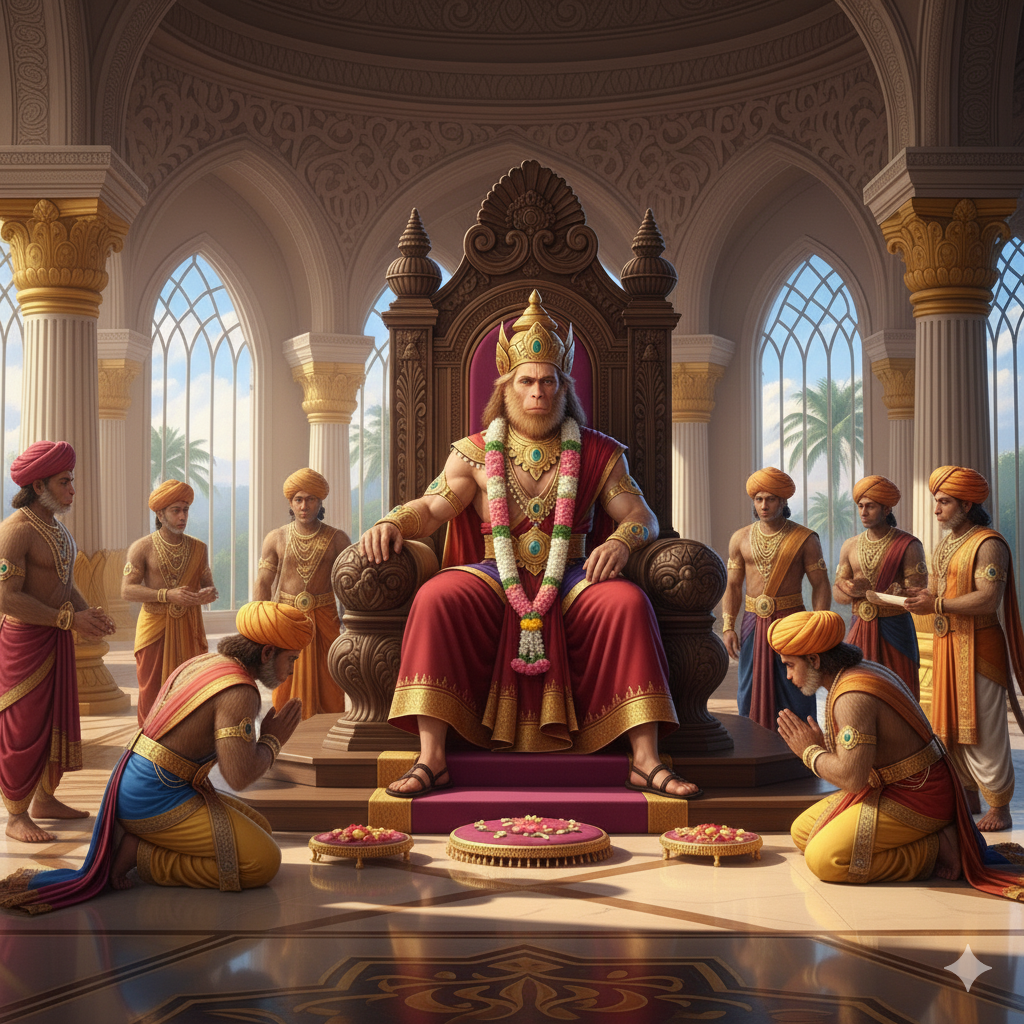
Explore sacred Hindu Pilgrimage Sites (destinations) reflecting Hindu spiritual heritage across India and abroad.
Top Sacred Places in India
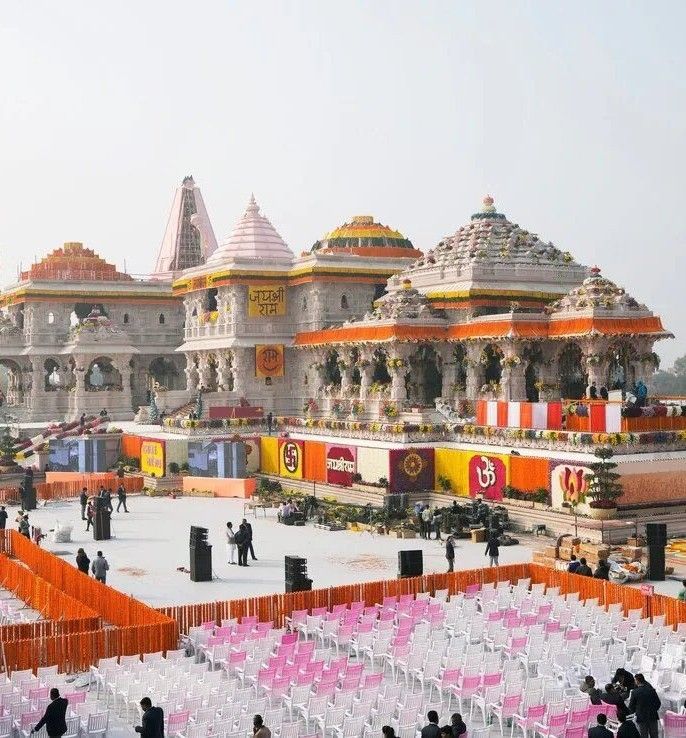
Ayodhya: Ram Janmabhoomi, birthplace of Lord Rama, a major center for devotion and celebration.
Kashi (Varanasi): Kashi Vishwanath Temple, holy city for liberation and ritual purification in Ganga.
Puri: Jagannath Dham, temple of Lord Jagannath, one of the Char Dham.
Tirupati: Venkateswara Temple, richest and most visited pilgrimage site.
Badrinath: Char Dham, sacred site in Himalayas, abode of Lord Vishnu.
Haridwar & Rishikesh: Gateway to Himalayas, holy Ganga ghats, vibrant temple traditions.
Dwarka: Dwarkadhish Temple, Lord Krishna’s ancient kingdom, part of Char Dham.
Rameshwaram: Ramanathaswamy Temple, associated with Rama, Char Dham and Jyotirlinga.
Mathura-Vrindavan: Birthplace and divine play-ground of Lord Krishna.
Kedarnath: Shiva Jyotirlinga temple in Himalayan mountains.
Ayodhya: Ram Janmabhoomi- Ram Temple
Ayodhya: Ram Janmabhoomi, birthplace of Lord Rama, a major center for devotion and celebration.
1. Mythological and Scriptural Roots
- Birthplace of Lord Rama:
Ayodhya is revered as the exact birthplace of Lord Rama, the seventh incarnation of Lord Vishnu. The site known as Ram Janmabhoomi (“birthplace of Rama”) has been described for centuries in Hindu tradition and scriptures as the sacred spot where Rama took birth to King Dasharatha and Queen Kaushalya. - Central Role in the Ramayana Epic:
The Ramayana, composed by Sage Valmiki, narrates the life, virtues, and heroic journey of Lord Rama. Ayodhya is depicted as the splendid capital of Kosala, under Rama’s just and compassionate rule. His narrative includes exile, battles with demons, victory over Ravana, and his return that symbolizes the restoration of dharma (righteousness). - Symbolism of Dharma and Ideal Kingship:
Ayodhya stands in scriptures as the model city—a kingdom marked by prosperity, justice, compassion, and spiritual harmony under Rama, the ideal king (Maryada Purushottama). The concept of “Ram Rajya,” describing a state governed by high moral principles and the welfare of people, originates here and is often invoked in Indian philosophy and governance. - Sacred Geography and Status:
The Ramayana describes Ayodhya’s sacred geography—its grand palaces, flourishing gardens, and temples, emphasizing its spiritual reverence. The city is celebrated not only during Rama’s birth festival, Ram Navami, but also as one of the ‘Sapta Puri,’ the seven most holy pilgrimage centers in Hindu faith. - Enduring Pilgrimage and Worship:
For millennia, Ayodhya and Ram Janmabhoomi have attracted pilgrims seeking blessings, spiritual merit, and a living connection with the divine child form of Rama, known as Ram Lalla. Devotees believe visiting this site grants special spiritual virtues, renewal of faith, and a sense of entering the legendary epic itself. - Mythological Continuity and Cultural Identity:
The city’s mythological roots and narrative have shaped the religious consciousness of generations. From ancient texts to oral traditions, Ayodhya is deeply entwined with themes of virtue, sacrifice, justice, and the eternal victory of good over evil—the very core of Hindu worldview.
Ayodhya’s Ram Janmabhoomi thus transcends history and politics, representing in Hindu consciousness a timeless source of spiritual inspiration, cultural identity, and ethical example, as preserved in the epic Ramayana and countless other scriptures.
2. Historical Evolution
Ancient and Medieval Era
- Ayodhya is deeply revered as Lord Rama’s birthplace, celebrated in scriptures and local traditions for millennia.
- In 1528 CE, Mir Baqi, a commander of Mughal emperor Babur, constructed the Babri Masjid on land believed to be the original site of the Ram Janmabhoomi temple.
- Periods of relative peace alternated with tension, and Akbar’s administration permitted Hindu worship on a platform (Ram Chabutra) near the mosque.
Early Modern Era: Disputes Begin
- Local Hindus continued to seek access for worship and, over centuries, communal strains grew stronger.
- In 1853, Hindu ascetics occupied the Babri Masjid site, leading to administrative division: Hindus and Muslims were allocated separate worship areas within the precincts.
- In 1885, Mahant Raghubar Das filed a lawsuit seeking temple construction rights—dismissed by British courts, but lawsuits and public demands continued to grow.
20th Century: Escalation of Dispute
- In December 1949, idols of Rama and Sita were placed inside the mosque, intensifying religious sentiment.
- The government took control of the site and permitted Hindu worship, but legal and communal tensions continued.
- Multiple court cases were filed between Hindu organizations (Hindu Mahasabha, Nirmohi Akhara, VHP, etc.) and Muslim groups (Sunni Waqf Board) over control and ownership of the site.
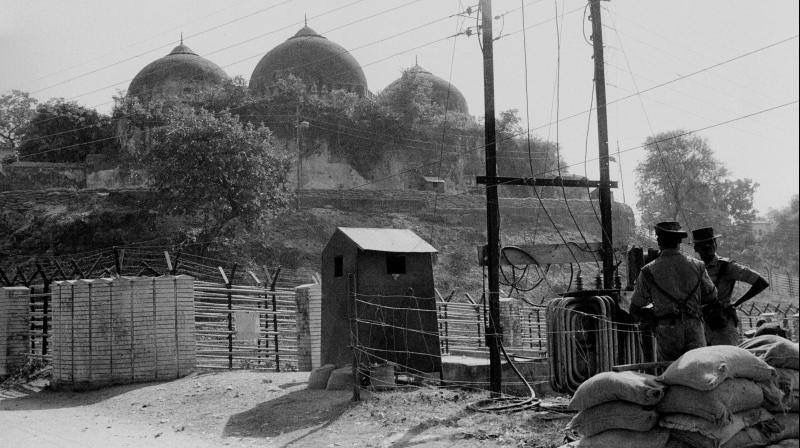
Disputed structure in the Ram Temple premises
Mass Movement and Political Mobilization
- In the 1980s, the Ram Janmabhoomi movement gained national momentum, with the Vishwa Hindu Parishad (VHP), RSS, and Bharatiya Janata Party (BJP) mobilizing for temple construction.
- In 1986, the court ordered the opening of doors for Hindu worship inside the mosque.
- The Rath Yatra of 1990, led by LK Advani, further rallied mass support.
Babri Masjid Demolition and Legal Battles
- On December 6, 1992, the Babri Masjid was demolished by kar sevaks, leading to nationwide unrest and lengthy judicial investigations.
- The Liberhan Commission and other inquiries examined the circumstances and repercussions of the demolition.
Supreme Court Verdict and Temple Construction
- In November 2019, India’s Supreme Court ruled that the disputed land be given to Hindu representatives for temple construction and directed an alternative land be given for a mosque.
- Groundbreaking (Bhoomi Pujan) took place in August 2020, followed by large-scale temple construction and planning for a grand structure reflecting ancient traditions.
Inauguration and Contemporary Status
- The Ram Mandir site is now a major pilgrimage destination, with the temple officially inaugurated and open for global devotees.
- The site’s journey—marked by faith, controversy, legal battles, and eventual resolution—illustrates a remarkable transformation from ancient reverence to modern reconciliation.
Ayodhya’s Ram Janmabhoomi thus represents a rich tapestry of spiritual tradition, historical change, communal negotiation, and national significance over centuries.
3. The Ram Janmabhoomi Movement
Origin of the Ram Janmabhoomi Movement
- The movement arose as a religious and cultural revival seeking to reclaim the birthplace of Lord Rama in Ayodhya, focusing on reconstructing the ancient Ram temple believed to have been destroyed to build the Babri Masjid.
- It gained momentum in the 20th century through activism by the Vishwa Hindu Parishad (VHP), Bharatiya Janata Party (BJP), and Rashtriya Swayamsevak Sangh (RSS), mobilizing public opinion and pursuing legal remedies.
Landmark Episodes in the Movement
- The 1986 unlocking of the Babri Masjid doors for Hindu worshipers marked a significant turning point, reinforcing religious sentiments linked to the site.
- The 1990 Rath Yatra led by LK Advani mobilized millions of supporters nationwide advocating for Ram temple construction, intensifying political and social discourse.
- The demolition of Babri Masjid in 1992 was a contentious climax, ultimately accelerating legal battles and nationwide debate.
Legal Resolution and Temple Construction Approval
- After protracted litigation, the Supreme Court’s November 2019 verdict officially awarded the site for the construction of Ram Mandir, with a neighboring land allocated for mosque construction to foster harmony.
- This historical verdict paved the way for the formal temple construction and renewed zeal for completing the sacred project.
Temple Construction Principles Based on Vastu Shastra
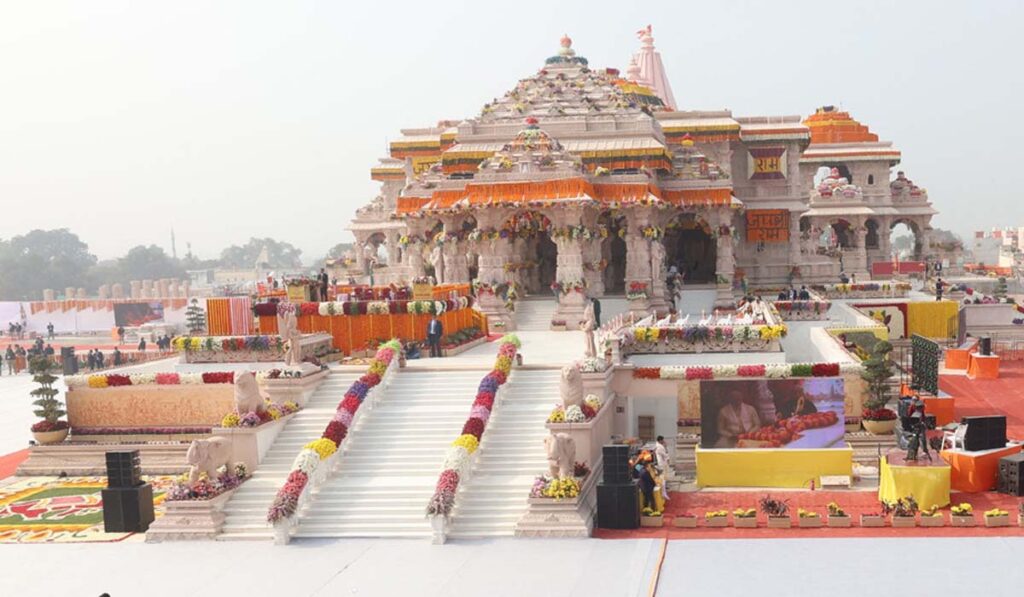
- The Ram Mandir is being designed as per Vastu Shastra, the ancient Indian science of architecture and spatial design governing temple construction, ensuring harmony with cosmic energies and natural laws.
- Key elements of Vastu compliance include:
- Orientation of the sanctum (garbhagriha) towards the east for auspicious energy flow.
- Symmetry and proportion in temple layout reflecting cosmic principles.
- Use of sacred geometry and specific design motifs symbolizing spiritual concepts.
- Material selection focused on purity and tradition, such as sandstone and marble.
- Inclusion of ritual spaces like the Antarala, Mandapa, and Pradakshina paths as per classical texts.
Modern Infrastructure with Traditional Architecture
- While preserving Vastu principles, the temple incorporates modern engineering to ensure longevity, visitor comfort, and accessibility for millions of pilgrims.
- The collaborative effort involves experienced architects, Vastu experts, artisans, and spiritual leaders guiding the project.
Symbolism and Spiritual Vision
- The Vastu-based design not only fulfills structural requirements but also aims to evoke a profound spiritual experience, connecting devotees with Lord Rama’s divine presence.
- As a living embodiment of Dharma, the temple’s architecture narrates tell stories from Ramayana through intricate carvings and iconography.
The Ram Janmabhoomi Movement reflects a collective aspiration to restore cultural and spiritual heritage, culminating in a temple that honors ancient sacred traditions, built with Vastu-compliant precision to inspire faith and unity for generations ahead.Here is a systematic pointwise article on “The Ram Janmabhoomi Movement and Temple Construction as per Vastu”:
4. Significance of the Ram Mandir
Religious Significance
- The Ram Mandir marks the sacred birthplace of Lord Rama, the seventh avatar of Vishnu, central to Hindu faith and worship.
- It serves as a major pilgrimage site where millions of devotees participate in daily worship, rituals, and festivals such as Ram Navami and Diwali, celebrating Rama’s life and values.
- The temple symbolizes the triumph of dharma (righteousness) over adharma (wickedness), underscoring Lord Rama’s embodiment of virtue, justice, and moral integrity.
Cultural Importance
- Ram Mandir is a beacon of Indian culture and heritage, embodying centuries of Hindu traditions, arts, architecture, and values.
- It is a cultural hub where religious festivals, community gatherings, and spiritual discourses take place, fostering unity and cultural pride among Hindus worldwide.
- The temple’s design showcases intricate craftsmanship inspired by ancient temple architecture, promoting Indian art and tradition.
Spiritual Significance
- The temple provides a sacred space that connects devotees directly with the divine presence of Lord Rama, enhancing spiritual devotion and inner growth.
- It offers a tranquil atmosphere for meditation, prayer, and contemplation inspired by the virtues of Lord Rama, especially his steadfastness, compassion, and commitment to dharma.
- As a place believed to grant moksha (liberation), Ram Mandir draws devotees seeking spiritual upliftment and grace.
Symbol of Faith and Unity
- Beyond its religious significance, the Ram Mandir stands as a symbol of cultural unity, representing centuries-old faith and collective identity for Hindus worldwide.
- It bridges regional and social divides, encouraging a shared respect for heritage and spiritual values.
- The temple’s completion after decades of struggle signals harmony and reconciliation, inspiring hope and solidarity.
Economic and Developmental Impact
- The temple has catalyzed the transformation of Ayodhya into a vibrant spiritual and tourist hub, promoting economic growth and local employment opportunities.
- Infrastructure development around Ayodhya, such as roads, airports, and hospitality services, is revitalizing the region, benefitting residents and pilgrims alike.
Legacy and Future
- Ram Mandir preserves and promotes the teachings of the Ramayana, influencing education, literature, arts, and moral values across generations.
- It is envisioned as a center not only for worship but also for cultural exchange and spiritual learning for future centuries.
The Ram Mandir thus stands as a cornerstone of religious faith, cultural heritage, spiritual sanctity, and social unity, making it a landmark of immense significance for India and Hindu devotees worldwide.
- The temple is a symbol of the enduring devotion to Lord Rama and serves as a reminder of cultural unity, coexistence, and heritage preservation.
- Ram Janmabhoomi is one of Hinduism’s most important tirthas (sacred sites), drawing millions of pilgrims from India and the world every year.
- The site is revered for granting moksha (liberation) and is included among the seven Moksha-puris (holy cities of salvation) in Hindu belief.
5. Social, Cultural, and Economic Impact
Social Impact
- The Ram Mandir has fostered a renewed sense of identity and pride among Hindus across India and the diaspora, strengthening social cohesion rooted in shared spiritual heritage.
- The temple serves as a catalyst for community bonding, with festivals and religious events drawing diverse groups from different regions and backgrounds, promoting mutual understanding and respect.
- It has encouraged charitable activities, social welfare programs, and educational initiatives spearheaded by temple trusts and associated organizations, enhancing social development in the region.
Cultural Impact
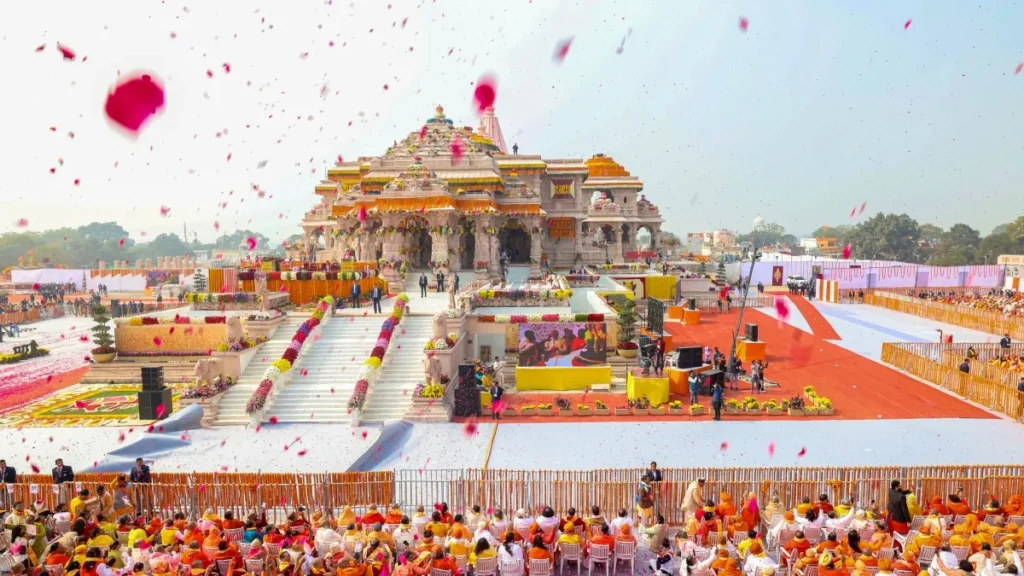
- The temple is a vibrant epicenter for preserving and promoting Hindu cultural traditions, rituals, music, dance, and arts inspired by the Ramayana and ancient texts.
- Its intricate architecture and sculpture work showcase India’s rich cultural legacy, revitalizing interest in traditional crafts and heritage conservation.
- The Mandir has inspired new cultural narratives, literature, and media focused on Rama’s ideals, spreading awareness of dharma, ethics, and Indian values globally.
Economic Impact
- Ram Mandir has significantly boosted tourism in Ayodhya, attracting millions of pilgrims annually, which has led to the growth of hospitality, transport, and retail sectors.
- Infrastructure development—including roads, airports, public amenities, and urban renewal—has accelerated in and around Ayodhya, fueling regional economic growth.
- The temple’s construction and continuous maintenance have generated employment opportunities, from artisans and construction workers to guides and service providers, positively impacting local livelihoods.
- The influx of tourists and devotees also spurs investment in small and medium enterprises, handicrafts, and cultural tourism, diversifying the local economy.
Symbolic National and Global Impact
- The Ram Mandir has become a prominent symbol of India’s religious heritage and cultural renaissance on the global stage, enhancing the country’s spiritual tourism appeal.
- It encourages intercultural dialogues and interest in Hindu philosophy, contributing to global awareness and respect for Indian traditions.
The Ram Mandir is thus not just a sacred space but a powerful social, cultural, and economic engine driving community upliftment, heritage preservation, and regional prosperity in Ayodhya and beyond.
- The construction and inauguration of the temple have promoted social service initiatives, major infrastructure projects, and increased domestic and international tourism in Ayodhya.
- It represents reconciliation after centuries of dispute, emphasizing the ideals of unity and shared national identity.
6. Pilgrimage Experience
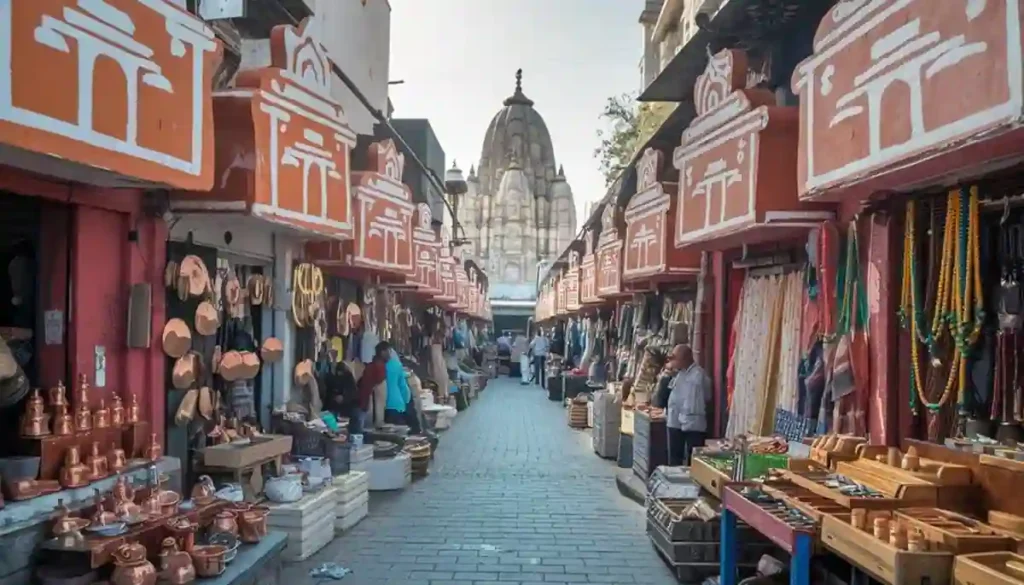
Spiritual Atmosphere and Significance
- Pilgrims experience a profound spiritual ambiance at Ram Janmabhoomi, believed to be the sacred birthplace of Lord Rama, offering a direct connection to divine grace and blessings.
- The temple complex provides spaces for meditation, prayer, and ritual, fostering a deep sense of devotion and inner peace.
Rituals and Worship Practices
- Daily worship includes traditional rituals such as aarti, bhajan-kirtan (devotional singing), and special pujas to Lord Rama and his consort Sita.
- Devotees participate in circumambulation (pradakshina) of the temple, a symbolic act of reverence and surrender.
- Festivals like Ram Navami (celebrating Lord Rama’s birth) and Diwali attract massive gatherings, with grand processions, religious discourses, and cultural programs.
Pilgrim Facilities and Hospitality
- The temple is equipped with modern amenities such as clean accommodation, food arrangements, and guidance centers to ensure a comfortable stay for the diverse global pilgrim population.
- Volunteer groups and temple management provide assistance in rituals, information, and crowd management to enhance the pilgrimage experience.
Cultural Immersion and Learning
- Visitors can attend lectures, storytelling sessions, and spiritual discourses illuminating the teachings of the Ramayana and the virtues of Lord Rama.
- The temple complex and surroundings offer rich cultural experiences, including traditional music, dance, arts, and local crafts.
Emotional and Transformational Impact
- Visitors often report a deep emotional connection, upliftment, and renewed faith after visiting the Ram Mandir.
- Many pilgrims come seeking spiritual solace, healing, and guidance, feeling a transformation in their personal and spiritual lives.
Accessibility and Inclusivity
- Efforts continue to improve accessibility for elderly, differently-abled, and international pilgrims, including transportation, signages, and multilingual support.
- The pilgrimage is open to all, regardless of caste, creed, or nationality, emphasizing universal values of love, devotion, and dharma.
The pilgrimage to Ram Janmabhoomi and Ram Mandir offers a unique blend of spiritual depth, cultural richness, and heartfelt devotion, making it a pivotal and life-enhancing journey for devotees worldwide.Here is a systematic, pointwise article about “Ayodhya: Ram Janmabhoomi” and the Ram Mandir Temple:
- Pilgrims visit to offer prayers, participate in elaborate rituals, and immerse themselves in the spiritual atmosphere of Ayodhya.
- Major festivals such as Ram Navami (the birth of Rama) and Diwali (his return to Ayodhya) are celebrated with grand processions and temple ceremonies.
Ayodhya’s Ram Janmabhoomi is more than a temple—it is a living embodiment of India’s mythological past, cultural resilience, and spiritual aspirations, inviting devotees to experience the legacy of Lord Rama in the timeless city of Ayodhya.
Courtesy: https://srjbtkshetra.org/
Kashi (Varanasi): Kashi Vishwanath Temple holy city for liberation and ritual purification in Ganga.
Ancient Significance
- The Kashi Vishwanath Temple is one of the most famous and sacred Hindu temples dedicated to Lord Shiva, located on the western bank of the Ganges River in Varanasi, Uttar Pradesh.
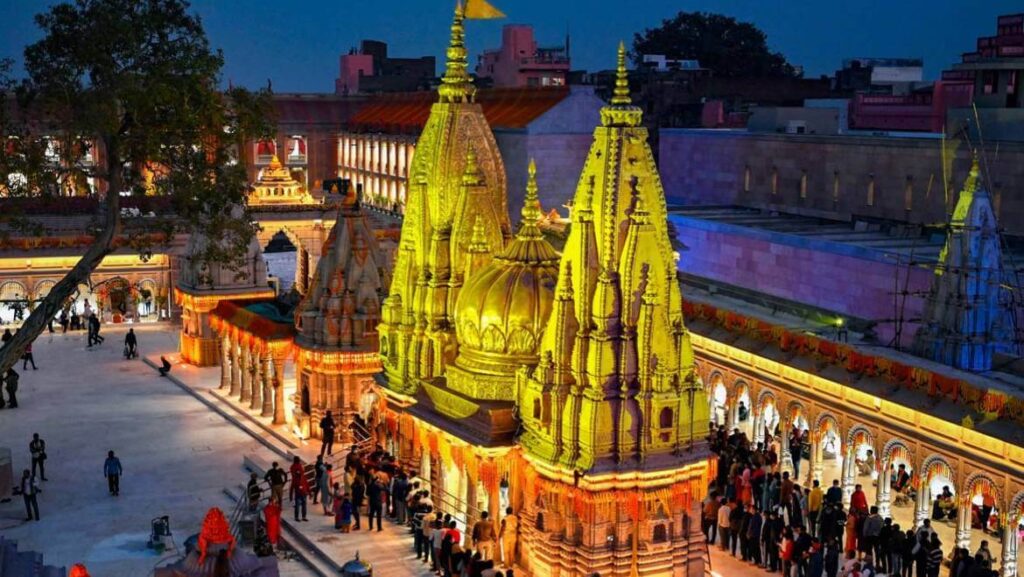
- Known as the “Golden Temple” due to its golden spire, the temple houses the Vishwanath Jyotirlinga, one of the twelve sacred Jyotirlingas of Lord Shiva across India.
- Varanasi (Kashi) is considered one of the oldest continuously inhabited cities globally and a major center of Hindu spirituality and learning.
Mythological Importance
- According to the Skanda Purana’s Kashi Khanda, Varanasi is a manifestation of Lord Shiva himself, and the temple is central to this sacred geography.
- One legend tells of Lord Shiva manifesting as an infinite pillar of light (Jyotirlinga), challenging Lord Brahma and Vishnu’s supremacy, establishing Kashi Vishwanath as a powerful spiritual site.
- It is believed that a single visit to this Jyotirlinga grants the merit of visiting all twelve Jyotirlinga temples, symbolizing liberation (moksha) from the cycle of rebirth.
Historical Evolution
- The original temple was destroyed and rebuilt several times due to invasions, especially by Muslim rulers like Qutbuddin Aibak and Aurangzeb, who demolished it in 1669 to build the Gyanvapi Mosque nearby.
- The current structure was built in the 18th century by Maharani Ahilyabai Holkar of Indore, showcasing Nagara style Hindu temple architecture with beautiful golden spires donated by Maharaja Ranjit Singh.
- Recent enhancements include the Kashi Vishwanath Corridor project connecting the temple with the Ganges ghats to facilitate pilgrim movement.
Architectural and Cultural Highlights
- The temple’s architecture features a quadrangular layout with the main Shiva Lingam placed on a silver altar in the garbhagriha (sanctum sanctorum).
- The golden spires, intricate carvings, and adjoining shrines—including the famous Maa Annapurna temple—make it a cultural hub for devotees and tourists alike.
- It plays a pivotal role during religious festivals like Mahashivaratri and is integral to Varanasi’s identity as a spiritual capital.
Pilgrimage and Spiritual Experience
- Pilgrims believe that a visit to Kashi Vishwanath and a dip in the Ganges cleanses sins and leads to liberation (moksha).
- The temple is also known for the blessings of Maa Annapurna, the goddess of nourishment whose temple is adjacent and signifies abundance and sustenance.
- The spiritual ambiance of Kashi Vishwanath has attracted saints, sages, and seekers, including Adi Shankaracharya, Ramakrishna Paramahamsa, and Swami Vivekananda, reinforcing its timeless significance.
Kashi Vishwanath Temple stands as a luminous beacon of Hindu devotion, history, architecture, and spirituality. It remains an essential pilgrimage site, embodying the quest for moksha and divine connection through Lord Shiva’s eternal Jyotirlinga in the sacred city of Varanasi.
History of Lord Jagannath (Lord of the Universe)
The Ancient Origins: The Legend of Neela Madhava
The worship of Lord Jagannatha is believed to date back to the prehistoric era. According to legends, Lord Jagannatha was originally worshipped as Neela Madhava, a form of Lord Vishnu, by a tribal king named Viswavasu in a secluded forest.
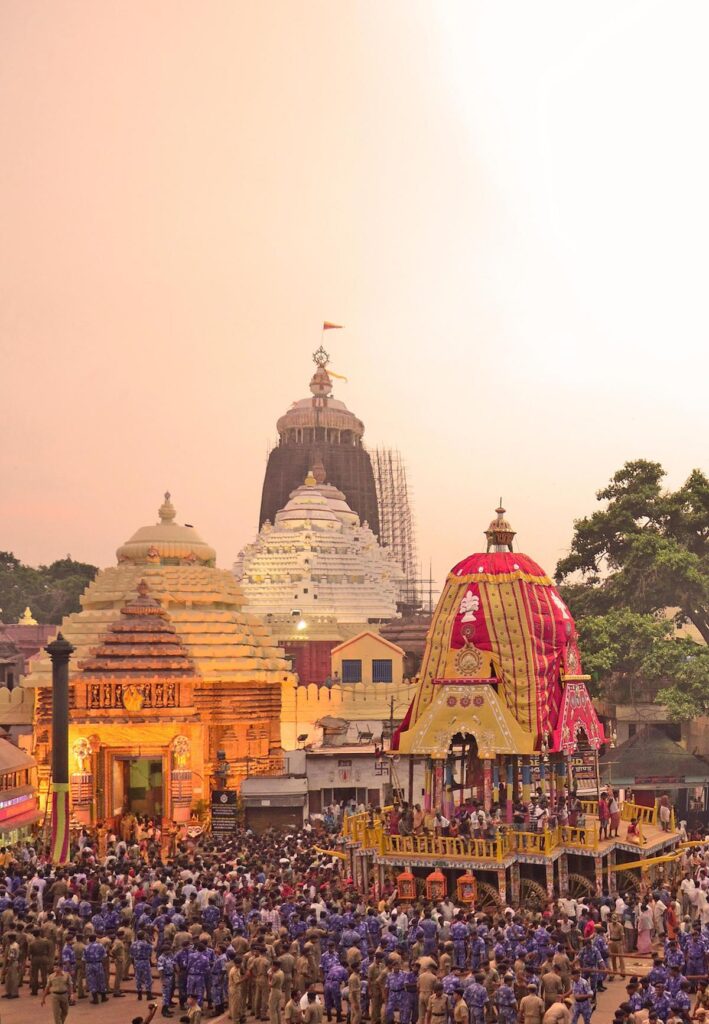
Puri Jagannath Temple
King Indradyumna’s Divine Temple Vision
As stated in the myth, King Indradyumna of Malwa, an ardent believer of Vishnu, got to know about Neela Madhava and sent his priest, Vidyapati, to find the deity. Vidyapati found out that this form was secretly worshipped by Viswavasu but he would not reveal its location. But by the divine fate, King Indradyumna was finally led to the holy Daru Brahma, a divine neem log which was floating on the sea of Puri.
The story of the Jagannath temple in Puri begins with King Indradyumna, a pious and powerful ruler from Ujjain, who received a divine vision or command from Lord Vishnu. He was instructed to establish a grand temple for Jagannath, the Lord of the Universe, by the sea. The deity Jagannath is understood as a form of Vishnu and an aspect of Krishna; legend holds that after Krishna’s earthly pastimes concluded, his bones were preserved in a sacred box. The king was directed to create the idol from a divine log of wood, or Daru, which would miraculously wash ashore near Puri.
To carve the idols, King Indradyumna commissioned Vishwakarma, the divine architect of the gods. Vishwakarma agreed to work on the condition of complete solitude until the task was finished. However, the king’s impatience grew, and he eventually forced his way into the workshop. This interruption caused Vishwakarma to vanish, leaving the idols of Jagannath, his brother Balabhadra, and sister Subhadra incomplete, notably without fully formed arms or legs. Despite their unusual form, the deities were consecrated with great ceremony. It is believed that Lord Brahma himself performed the rite of opening the eyes of Jagannath, infusing the idol with divine life, and the unique limbless form came to symbolize the Lord’s transcendent mystery and unconditional accessibility to all devotees.
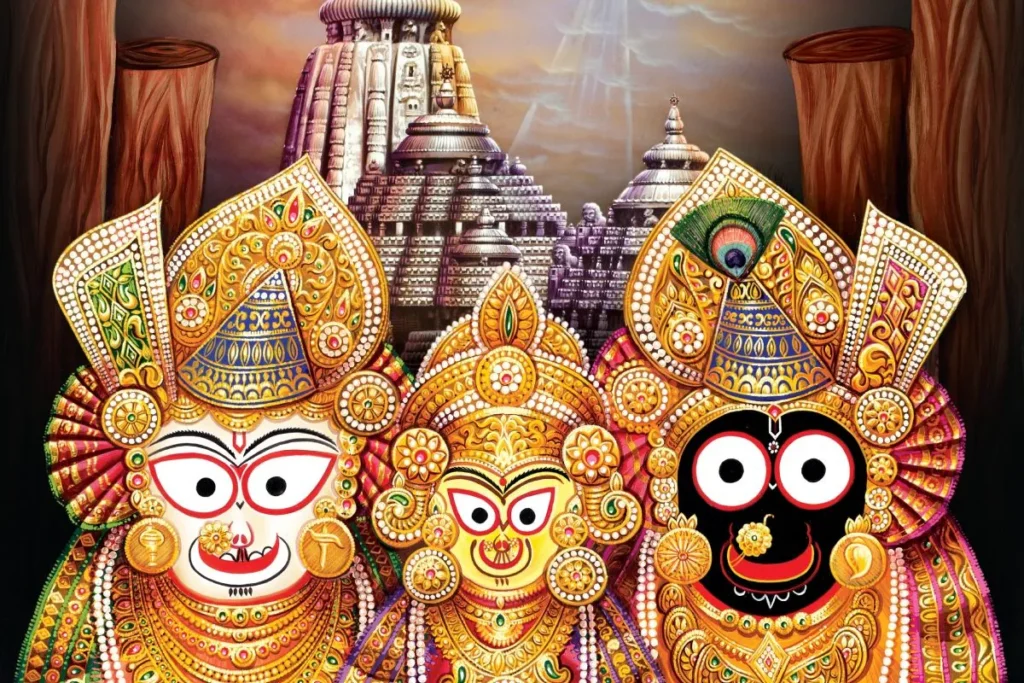
The Three Deities- Jagannath, Balabhadra and Subhadra
The origins of Jagannath worship are also deeply connected to pre-existing tribal traditions, reflecting a synthesis of cultures. Before King Indradyumna’s time, a tribal deity known as Nilamadhava was secretly worshipped by a Savara tribal chief named Viswavasu. The king’s emissary, Vidyapati, managed to locate this hidden deity by marrying Viswavasu’s daughter. This narrative thread highlights how the Jagannath tradition seamlessly blends indigenous tribal spiritual elements with mainstream Vedic practices. Consequently, the deity symbolizes a universal god who integrates diverse cultural roots into a single, unifying form of worship.
This holy wood was then used to create the idols of Lord Jagannatha, his younger brother Balabhadra and his sister Subhadra, as well as the divine Sudarshana Chakra.
The origin myth of Lord Jagannath is rich with legendary and spiritual narratives blending tribal, Hindu, and Vaishnavite traditions. According to popular Hindu texts like the Skanda Purana and Brahma Purana, as well as local folklore from Odisha:
In sum, Lord Jagannath’s origin is a divine synthesis of ancient tribal worship, royal vision, Vaishnavite devotion, and cosmic mystery preserved in the form of the unique wooden idols worshipped in Puri.
The Grand Temple of Jagannatha
Today’s Jagannatha Temple was a 12th century construction, started by King Anantavarman Chodaganga Deva of the Eastern Ganga dynasty and continued by Anangabhima Deva III. This towering temple is one of India’s holiest pilgrimage sites and was built in the Kalinga architectural style. The rituals performed at the temple are entirely unique in that they combine ancient tribal traditions, Vaishnavism and Tantric influences, and thus Lord Jagannatha is a universal deity who transcends religious and social boundaries.
Where as other traditional Hindu deities are partial, Lord Jagannatha is round eyed, incomplete and limbless. This is a unique appearance which has a significant spiritual meaning:
- His huge, circular eyes are a sign of his vigilance towards the people of this world.
- The absence of the hands and feet means that he walks and gives his blessings only through the devotion of his devotees.
- He is a divine form which is incomplete in order to depict the fact that there is no way of defining the divine in a human like form.
- He also embraces the followers of Lord Vishnu, Krishna and even Buddha and thus represents the universal deity.
A Deity Beyond Boundaries
He is not just the Lord of Odisha, he is the Lord of the Universe (Jagat-natha). The temple traditions, including Mahaprasad, a meal prepared in earthen pots, are symbols of equality and unity, served to all devotees irrespective of caste, creed, or status. The annual Ratha Yatra, the festival where the deities are taken out on huge chariots through the streets of Puri, illustrates his all embracing love for humanity. The festival is one of the oldest and largest religious processions in the world symbolizing the deities coming out of the temple to bless all beings.
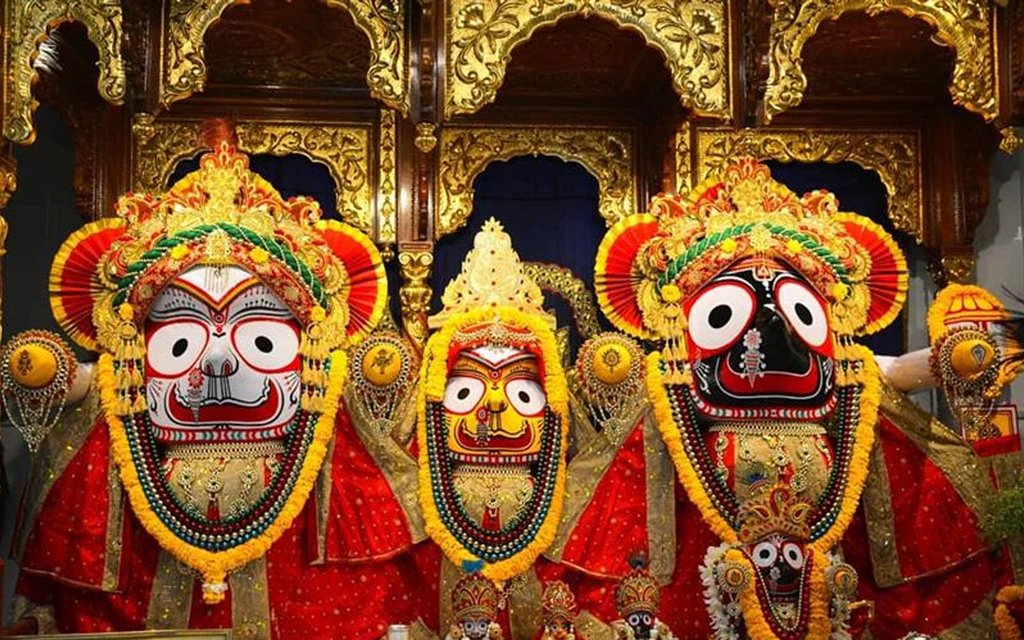
The Puri Rath Yatra, also known as the Jagannath Chariot Festival, is a grand annual Hindu festival held in Puri, Odisha, celebrating Lord Jagannath, his brother Balabhadra, and sister Subhadra. It is one of the oldest and largest chariot festivals in the world.
The story of Lord Jagannath, Balabhadra, and Subhadra is a unique and profound narrative that blends Vedic philosophy, local tribal traditions, and divine mystery. Here are the key facts about the deities and their sacred union.
1. The Divine Siblings: Identities and Symbolism
The trio worshipped in the Puri temple represents a holy trinity of siblings:
- Lord Jagannath: He is revered as a form of Lord Vishnu and, more specifically, Lord Krishna. The name “Jagannath” means “Lord of the Universe” (Jagat meaning universe, Nath meaning Lord). His unique iconography—large, round eyes without arms or legs—symbolizes his all-pervading, formless nature. He is the center of the universe and the embodiment of divine love and compassion, accessible to all.
- Balabhadra (Balarama): He is the elder brother of Jagannath (Krishna). Balabhadra, also known as Balaram, is depicted as white in color and is associated with strength (bala), agriculture, and the farmer community. He carries a plough (hala) and a mace (musala), symbolizing both nurturing power and protective strength. He represents the ideal of duty and support.
- Subhadra: She is their younger sister. Her name means “very auspicious.” Subhadra symbolizes the divine mother energy (Shakti) and spiritual bliss. Positioned between her two brothers, she represents the path of devotion that balances the power of Balabhadra (duty) and the compassion of Jagannath (love). In some interpretations, she is also seen as an aspect of Durga or the celestial goddess Lakshmi.
2. The Legend of Their Origin: The Story of King Indradyumna
The primary legend explaining their appearance begins with King Indradyumna, a devout king of Malwa. He had a divine dream instructing him to build a grand temple for Lord Vishnu in the form of Nila Madhava (a blue-colored form of Vishnu) who was being worshipped in secret by a tribal chief, Viswavasu. The king sent a Brahmin priest, Vidyapati, to locate the deity. After many trials, Vidyapati succeeded and married the tribal chief’s daughter.
However, by the time King Indradyumna arrived, the deity of Nila Madhava had disappeared. Distraught, the king was determined to find the Lord. A divine voice (Akashvani) then instructed him to retrieve a sacred, floating log of wood (daru) that would wash ashore at Puri. The king found the log, which was radiant and bore the divine symbols of a conch (shankha) and discus (chakra).
3. The Divine Carving and the Incomplete Idols
King Indradyumna prayed for a sculptor to carve the deities from the divine log. The heavenly architect, Vishwakarma, appeared as an old carpenter but set a condition: he must not be disturbed until the work was complete. The king agreed, and Vishwakarma began his work behind closed doors. Weeks turned into months, and hearing no sound from inside, the anxious queen persuaded the king to check. Forced by concern, the king opened the doors.
This interruption caused Vishwakarma to vanish instantly, leaving the idols unfinished. They lacked fully formed hands and feet. The king was heartbroken, but the same divine voice consoled him, stating that this form was the Lord’s chosen manifestation. The deities—Jagannath, Balabhadra, and Subhadra—were thus accepted in their unique, limbless form. It is said that Lord Brahma himself descended to perform the consecration ceremony, opening the eyes of the idols (Netrotsava) and infusing them with divine life (Prana Pratishtha).
4. The Tribal Connection and the Significance of the Trio
An essential aspect of the story is its deep connection to tribal (Adivasi) traditions. The initial worshipper of Nila Madhava was a tribal chief, and the carpenter community (a tribal group) is still intimately involved in the construction of the chariots for the annual Rath Yatra. The unique, aniconic (non-humanoid) form of the deities is very similar to tribal worship of sacred logs or stones.
This narrative signifies a profound syncretism—the harmonious blending of classical Vedic (Brahminical) traditions with ancient indigenous tribal worship. The trio together represents a universal family:
- Jagannath (Krishna) represents the Supreme Godhead.
- Balabhadra (Balarama) represents the world of physical and social duty (Samsara).
- Subhadra represents the spiritual energy (Shakti) that connects the individual soul to God.
Their placement together—Jagannath and Balabhadra on either side of Subhadra—teaches that the path to the divine (Jagannath) is navigated by balancing worldly responsibilities (Balabhadra) with spiritual devotion (Subhadra). This makes the worship of Jagannath uniquely inclusive, transcending barriers of caste, creed, and philosophical differences, truly embodying the spirit of the “Lord of the Universe.”
About Rath Yatra
The festival commemorates the divine annual journey of the three deities from the main Jagannath Temple to the Gundicha Temple, which is thought to be the home of their maternal aunt. This journey symbolizes the Lord’s visit outside the temple to bless devotees and represents a divine homecoming, reinforcing bonds of kinship and compassion. It also allows devotees from all backgrounds to have darshan (see the deities) directly, as the deities are taken out of the temple, breaking social barriers of caste and status.
The Jagannath Rath Yatra in Puri is a spectacular symphony of faith, artistry, and ancient tradition, far surpassing a mere procession. Each year, this event unfolds with breathtaking precision, governed by rituals that have remained unchanged for centuries. The preparation begins on Akshaya Tritiya, when approximately 200 skilled artisans commence the sacred task of constructing three colossal chariots entirely from scratch. Using traditional tools and techniques passed down through generations, they build these towering structures without a single metal nail. The wood is sourced from specific trees in the secret forests of Nayagarh, marked by sacred symbols, ensuring that the size and design of the chariots are replicated with spiritual exactness year after year. The grandeur is completed with vibrant canopies, each crafted from over 1,200 meters of cloth, hand-stitched by a dedicated team of tailors, creating a divine spectacle even before the journey begins.
The rituals surrounding the Yatra are as profound as the chariots themselves. Days before the festival, the deities are given a ceremonial bath on Snana Purnima, after which they are believed to fall into a divine state of convalescence known as Anasara. Secluded for 15 days, they are treated with herbal remedies by the temple priests. On the day of the Yatra, the Gajapati King of Puri performs the powerful ‘Chhera Pahanra’ ritual, sweeping the chariot platforms with a golden broom to symbolize that everyone is a humble servant before God. The procession is initiated with the earthy, rhythmic chants of the Dahuka Boli, verses meant to energize the chariots. A key mystery of the event is that Lord Jagannath’s chariot, pulled by thousands on ropes made of 8-inch-thick coconut fibre, is said not to move until immense devotional effort is exerted, a testament to the Lord’s divine will.
The Yatra’s spiritual significance is immense, attracting over a million devotees annually for a chance at darshan, as non-Hindus are not permitted inside the temple. Sacred texts promise liberation from the cycle of rebirth for those who witness the deities on their chariots. The journey is filled with divine drama: during their stay at the Gundicha Temple, the deities are offered Poda Pitha, a special pancake without which Lord Jagannath is believed to delay his return. Furthermore, Goddess Lakshmi, having been left behind, visits the chariots on the fifth day in a ritual called Hera Panchami, playfully damaging a part to express her marital displeasure. This living tradition, which some accounts even link to a visit by Jesus Christ, is a timeless celebration where faith, humility, and cosmic play converge on the Grand Road of Puri.
In essence, the Puri Rath Yatra is a powerful symbol of divine grace reaching out to all, promoting humility, unity, and spiritual fervor among devotees on an epic scale.
Leave a Reply