Who Are the Saptarishis?
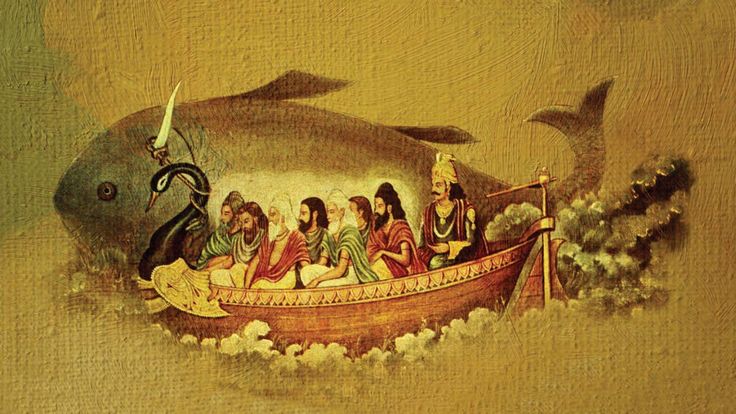
In the sacred tapestry of Indian mythology, the Saptarishis—the Seven Great Sages—stand as eternal beacons of wisdom, dharma, and divine purpose. Born from the mind of Lord Brahma, these sages were not ordinary mortals. They were cosmic architects, entrusted with preserving spiritual knowledge and guiding humanity through the cycles of time.
Their presence is not confined to scriptures alone—they are etched into the stars as the Ursa Major constellation, known in India as the Saptarishi Mandal. Each star represents a sage, reminding us that their wisdom is as vast and enduring as the cosmos itself.
The Seven Sages of the Current Age
In this Manvantara (cosmic cycle), the seven sages are:
1. The Timeless Saga of Sage Atri
- Father of Dattatreya, a composite incarnation of Brahma, Vishnu, and Shiva.
- Symbol of purity and divine grace.
- His wife Anasuya was so virtuous that the Trimurti themselves incarnated as her sons.
Full Story of Sage Atri
Divine Origin and Place Among the Saptarishis Sage Atri is one of the most revered figures in Hindu cosmology — counted among the Saptarishis (seven great sages) of the current age (Vaivasvata Manvantara). In the Vedic vision, he is a mānasaputra — a “mind-born son” of Lord Brahmā, symbolizing the tongue among Brahmā’s senses, representing the power of sacred speech and Vedic wisdom. The Rigveda honors him as a great seer (ṛṣi), with the entire Fifth Mandala (Book 5) — known as the Atri Mandala — attributed to him and his descendants. His hymns praise Agni, Indra, and other deities, revealing deep insight into cosmic order (ṛta). Marriage to Anasūyā – The Ideal of Devotion Atri’s consort was Anasūyā Devi, celebrated as one of the seven great pativratās (exemplary wives) in Hindu tradition. Her name means “free from envy,” and her virtue was so great that even the gods tested her chastity. The Purāṇas recount that once, the Trimūrti — Brahmā, Viṣṇu, and Śiva — appeared at their hermitage in disguise, asking Anasūyā to serve them food without wearing clothes. Through her spiritual power and purity, she transformed them into infants and fed them without violating her vow. Pleased, the three revealed themselves and granted boons to the couple.
The Birth of Three Divine Sons From these boons, the couple was blessed with three extraordinary sons, each an incarnation (aṁśa) of one of the Trimūrti: Chandra (Moon God) – aspect of Brahmā Dattātreya – aspect of Viṣṇu, later revered as a great teacher of yoga and Advaita Durvāsā – aspect of Śiva, known for his fiery temper and uncompromising adherence to dharma Austerities and the Vision of the Trinity The Bhāgavata Purāṇa narrates that Atri and Anasūyā once performed intense austerities (tapas) on the Riksha mountains, seeking to please the Supreme Being. Their penance was so pure that all three deities — Brahmā, Viṣṇu, and Śiva — appeared together, a rare occurrence in Hindu lore. Atri prayed that the Supreme should be born to them, and thus the three divine sons came into the world. Role in the Epics In the Rāmāyaṇa, during Rāma’s exile, Rāma, Sītā, and Lakṣmaṇa visited Atri’s hermitage. Anasūyā welcomed Sītā with gifts of divine garments and ornaments, and offered her counsel on the duties of a devoted wife. Atri blessed Rāma and praised his adherence to dharma. In the Mahābhārata, Atri appears as a wise elder, offering counsel to kings and sages, reinforcing the eternal principles of righteousness.
Teachings and Philosophy From the Vedic hymns and Purāṇic stories, Atri’s philosophy emerges clearly: Unity of the Divine – seeing Brahmā, Viṣṇu, and Śiva as one Supreme Reality Power of Tapas – austerity and meditation as the path to divine realization Householder’s Dharma – showing that one can be a great sage while fulfilling family duties Speech as Sacred – as the embodiment of Brahmā’s tongue, Atri upheld truth and the sanctity of the spoken word.
Legacy Sage Atri’s lineage (Ātreya gotra) produced many seers who contributed to the Vedas. His son Dattātreya became a central figure in the Nath tradition and Advaita Vedānta. His life stands as a bridge between Vedic ritualism and Bhakti devotion, between ascetic renunciation and householder’s responsibility. Even today, his name is invoked in mantras, his hymns are recited in Vedic rituals, and his story is told as an example of purity, devotion, and divine grace.
2. Maharshi Bharadvāja – The Sage of Unquenchable Learning
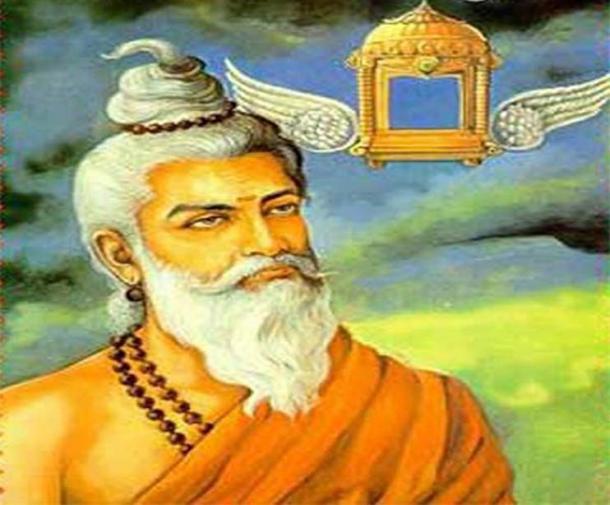
- Master of Ayurveda, Vedic sciences, and astronomy.
- His teachings laid the foundation for holistic healing and spiritual discipline.
- Revered as a teacher of gods and humans alike.
About Sage Bharadvaja
Vedic Origins Sage Bharadvāja (भरद्वाज) is one of the most celebrated Saptarishis of the current age (Vaivasvata Manvantara). In the Rigveda, he and his lineage (Bharadvāja gotra) are credited with composing Mandala 6, filled with hymns to Agni, Indra, and other deities. His name means “bringing nourishment” — symbolizing the sustenance of both body and spirit through wisdom. In some accounts, he is the son of Bṛhaspati (the guru of the Devas) and Mamata; in others, he is linked to Sage Atri’s lineage.
The Disciple of Vālmīki In the Rāmāyaṇa, Bharadvāja appears as a devoted disciple of Sage Vālmīki. He was present when Vālmīki witnessed the famous krauncha bird incident that inspired the first śloka (verse) of Sanskrit poetry. Bharadvāja served his guru with humility, learning not only the Vedas but also the art of poetic expression and the deeper truths of dharma
The Quest for Infinite Knowledge The Bhāgavata Purāṇa tells a striking story: Bharadvāja devoted thousands of years to studying the Vedas. Pleased with his dedication, Indra granted him repeated extensions of life. Finally, Indra showed him three massive mountains and gave him three handfuls of sand, saying: “What you have learned is like these grains; what remains is like these mountains.” Far from being discouraged, Bharadvāja continued his studies — a symbol of the endless pursuit of truth.
Role in the Rāmāyaṇa Bharadvāja’s hermitage was at Prayāga (modern-day Allahabad), near the confluence of the Ganga and Yamuna. When Rāma, Sītā, and Lakṣmaṇa began their exile, they visited him for blessings. Later, when Bharata came searching for Rāma to persuade him to return to Ayodhyā, Bharadvāja hosted him and his vast retinue. Using his yogic powers, he arranged a celestial feast, summoning Gandharvas, Apsarās, and divine musicians to honor the guests.
In the Mahābhārata Bharadvāja is also remembered as the father of Droṇācārya, the famed martial guru of the Pāṇḍavas and Kauravas. His wife was Suhotra (or in some accounts, Sushilā or Ilavida). Through his son Drona, Bharadvāja’s lineage played a pivotal role in the Kurukṣetra war. Contributions to Ayurveda The Charaka Saṃhitā credits Bharadvāja with bringing the science of Ayurveda to humanity: Seeing that illness hindered spiritual practice, he approached Indra for a remedy. Indra taught him the principles of health, which Bharadvāja then passed on to sages and physicians.
Philosophy and Legacy Bharadvāja embodies: Relentless learning – knowledge is infinite, and humility is the key to wisdom. Service to the guru – devotion to one’s teacher as a sacred duty. Integration of disciplines – mastery of Vedas, poetry, statecraft, martial training, and medicine. His gotra continues among Brahmins and Kshatriyas, and his name lives on in yoga (Bharadvājāsana), literature, and sacred geography.
3. Gautama – The Sage of Purity, Penance, and Dharma
Vedic Roots and Lineage
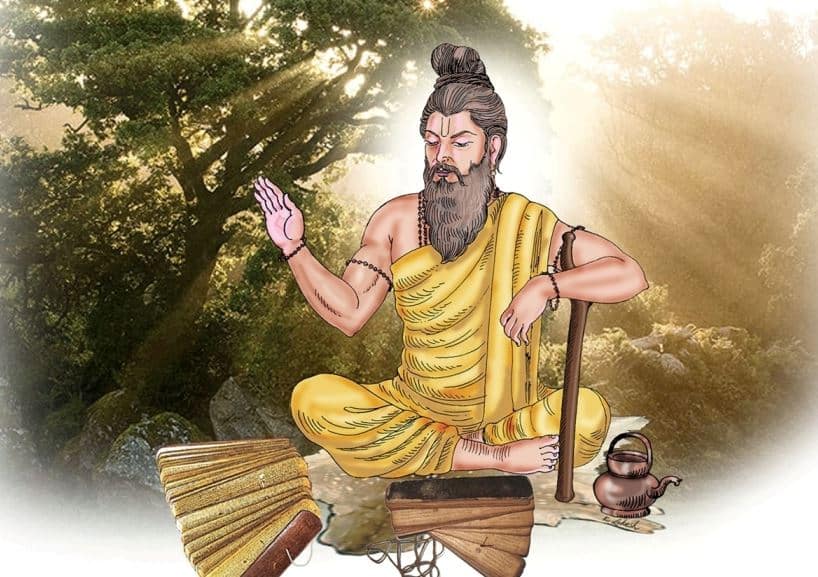
- Sage Gautama (महर्षिः गौतम) is counted among the Saptarishis of the current age (Vaivasvata Manvantara).
- He is said to be the son of Dirghatamas (or in some accounts, Rahugana) and belongs to the Angirasa lineage — one of the most ancient Vedic families.
- The Rigveda and Sama Veda contain hymns attributed to him, earning him the title Mantra-Drasṭā — “seer of mantras.”
Read the Full Story of Sage Gautama
Sage Gautama (महर्षिः गौतम) is counted among the Saptarishis of the current age (Vaivasvata Manvantara). He is said to be the son of Dirghatamas (or in some accounts, Rahugana) and belongs to the Angirasa lineage — one of the most ancient Vedic families. The Rigveda and Sama Veda contain hymns attributed to him, earning him the title Mantra-Drasṭā — “seer of mantras.”
Marriage to Ahalyā Gautama married Ahalyā, famed as one of the Panchakanyas (five legendary women of purity). According to the Purāṇas, Ahalyā was created by Lord Brahmā himself as the most beautiful woman in the universe and given to Gautama in marriage.They had children — most notably Śatānanda, the wise priest of King Janaka in the Rāmāyaṇa. Other traditions mention sons Śaradvān and Cirakārī, and daughters including Jaya, Jayantī, and Aparājitā.
The Ahalyā Episode One of the most famous episodes in Hindu lore involves Gautama, Ahalyā, and Indra: While Gautama was away, Indra, desiring Ahalyā, disguised himself as Gautama and approached her. When Gautama returned and discovered the deception, he cursed Indra — in some versions to bear a thousand marks (later transformed into eyes), in others to lose his manhood. He also cursed Ahalyā to become invisible or turn into stone, to be redeemed only when touched by the feet of Lord Rāma.
This redemption occurs in the Bāla Kāṇḍa of the Rāmāyaṇa, when Rāma visits Gautama’s hermitage during his exile. Creator of the Godavari (Gautamī) The Vāmana Purāṇa and local traditions of Maharashtra and Andhra Pradesh tell of Gautama’s role in bringing the sacred Godavari River to earth:
During a severe drought, Gautama’s penance pleased Varuṇa, who blessed his hermitage with rain. Out of compassion, Gautama cultivated crops and fed the hungry. Jealous sages sent a divine cow to his fields; when Gautama tried to drive it away, it died. Accused of killing a cow (go-hatyā), Gautama performed intense austerities to Lord Śiva for absolution. Śiva released the Ganga from his matted locks at Tryambakeshwar, and she flowed as the Godavari, sanctifying the land and washing away the sin.
In the Epics In the Rāmāyaṇa, his hermitage is a place of sanctity visited by Rāma, Sītā, and Lakṣmaṇa. In the Mahābhārata, Gautama appears as a wise elder and is also linked through his descendants to key characters — for example, Kṛpācārya and Kṛpī (wife of Droṇa) are from his lineage. Teachings and Legacy
Gautama’s life embodies: Tapas (Austerity) – using penance to invoke divine grace. Compassion – feeding and protecting others even in times of scarcity. Justice and Purity – upholding dharma even when it meant punishing those close to him. Sacred Geography – his association with the Godavari makes him central to the spiritual map of India. His gotra (Gautama gotra) continues among many Brahmin families, and his name is invoked in Vedic rituals. The Godavari is still called Gautamī in his honor.
4. Jamadagni – The Sage of Fiery Dharma
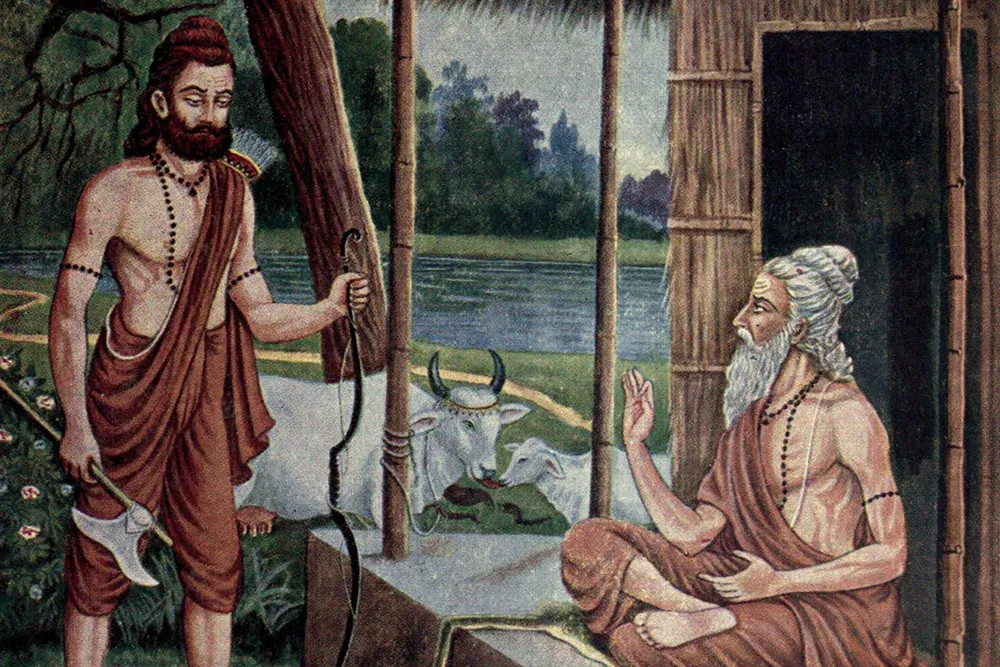
- Father of Parashurama, the warrior-sage.
- Embodiment of discipline and sacrifice.
- His tragic story reflects the tension between dharma and emotion.
Lineage and Birth Jamadagni (Sanskrit: “great fire”) was a descendant of the sage Bhrigu, one of the mind-born sons of Brahmā. His father was Sage Richika, and his mother Satyavatī, daughter of King Gādhi of the Lunar dynasty. His birth is tied to a famous legend: Richika prepared two portions of sanctified food — one infused with brahma-tejas (spiritual radiance) for Satyavatī, and one with kṣātra-tejas (warrior energy) for her mother. The two women secretly exchanged them.
As a result, Satyavatī gave birth to Jamadagni, imbued with the warrior’s fiery energy, while her mother bore Viśvāmitra, who was born with the spiritual radiance of a Brahmana but later became a warrior-turned-sage.
Marriage to Renukā In his youth, Jamadagni mastered the Vedas and the science of weapons. While traveling to holy places, he visited the court of King Prasenajit of the Ikṣvāku dynasty and married his daughter Renukā, famed for her chastity and devotion.They settled on the banks of the Narmadā River, living a life of penance and simplicity.
Children Jamadagni and Renukā had five sons: Ṛumaṇvān Suhotra Vasu Viśvāvasu Paraśurāma – the youngest, destined to become the sixth avatāra of Viṣṇu.
The Kamadhenu Episode Jamadagni possessed Kāmadhenu, the divine wish-fulfilling cow, gifted by the gods. King Kārtavīrya Arjuna (Sahasrārjuna), a mighty Kṣatriya, once visited Jamadagni’s hermitage and was lavishly fed through Kāmadhenu’s bounty. Coveting the cow, the king seized it by force. Paraśurāma, returning to the hermitage, pursued the king, slew him, and retrieved Kāmadhenu.
Renukā’s Ordeal One day, Renukā, while fetching water, saw a celestial couple sporting in the river and for a moment her mind wavered. Jamadagni, through his yogic vision, perceived this lapse and, in a moment of stern ascetic discipline, ordered his sons to behead her. All refused except Paraśurāma, who obeyed.
Pleased with his obedience, Jamadagni offered him a boon. Paraśurāma asked for his mother to be restored to life and for his brothers to be revived — which Jamadagni granted.
Martyrdom Seeking revenge for Kārtavīrya’s death, the king’s sons attacked Jamadagni’s hermitage when Paraśurāma was away. They beheaded the sage as he meditated. When Paraśurāma returned and saw his father slain, he vowed to rid the earth of oppressive Kṣatriyas, a vow he fulfilled in 21 campaigns, restoring balance between the warrior and priestly orders.
Legacy Jamadagni is remembered as one of the Saptarishis of the current Manvantara. His life embodies the fusion of Brahminical wisdom and Kṣatriya valor. His hermitage sites, especially at the confluence of the Narmadā and in present-day Maharashtra, remain places of pilgrimage. Through Paraśurāma, his lineage became a symbol of uncompromising dharma and the defense of righteousness.
5. Kashyapa – The Progenitor of Beings
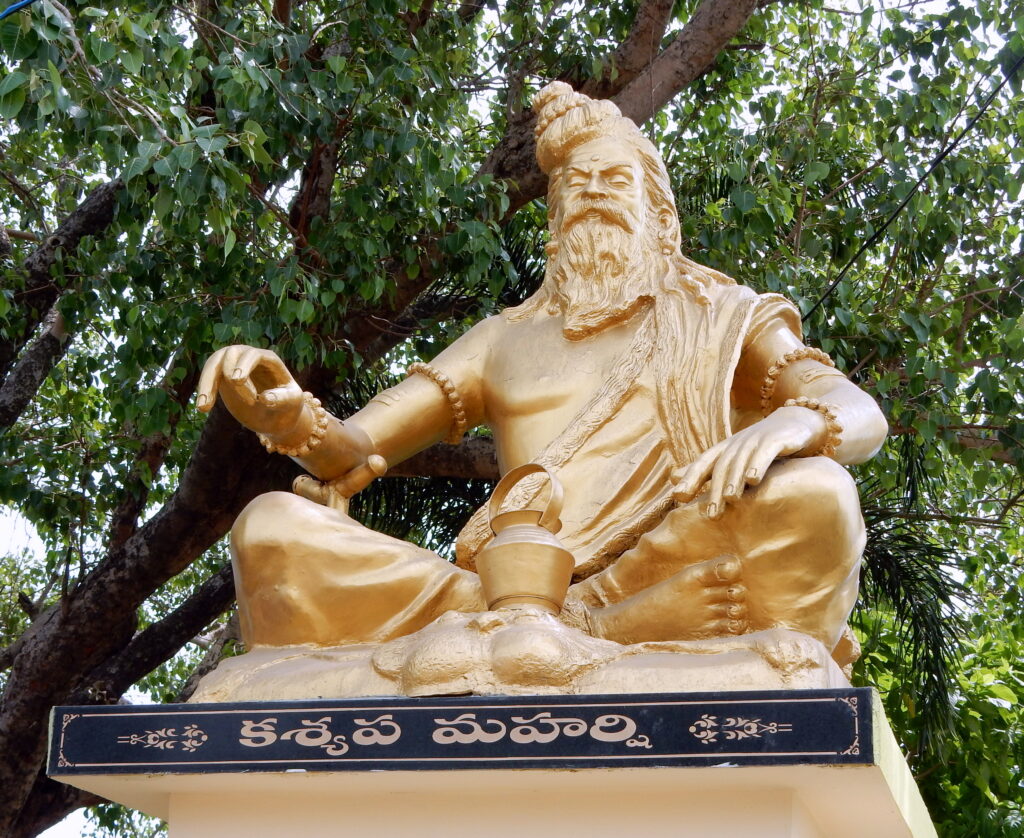
- Progenitor of all living beings—devas, asuras, nagas, birds, and humans.
- His lineage shaped the very fabric of creation.
- Symbol of cosmic fatherhood and balance.
Full Story about Sage Kashyapa
Vedic Origins Sage Kashyapa (कश्यप) is counted among the Saptarishis of the current age (Vaivasvata Manvantara) and is one of the most ancient seers mentioned in the Rigveda. He is the son of Marīchi (himself a mind-born son of Brahmā) and Kalā. The name Kashyapa is often interpreted as “tortoise” — symbolizing stability, patience, and the cosmic foundation. In the Vedas, Kashyapa and his lineage are credited with hymns, especially in Mandala IX, praising Soma Pavamāna.
The Great Patriarch Kashyapa is revered as a Prajāpati — a progenitor of countless beings. Through his many wives, he is said to have fathered almost every category of life in the universe.
Notable wives and their offspring (as per Purāṇic accounts): Aditi – Mother of the Ādityas (including Vāmana, an incarnation of Viṣṇu) and other Devas. Diti – Mother of the Daityas (powerful Asuras) like Hiraṇyakaśipu and Hiraṇyākṣa. Danu – Mother of the Dānavas. Kadru – Mother of the Nāgas (serpent beings) like Vāsuki. Vinata – Mother of Garuḍa (mount of Viṣṇu) and Aruṇa (charioteer of the Sun). Surabhi – Mother of celestial cows.
Muni, Ira, Tamra, Krodhavaśā, and others – Ancestresses of various birds, animals, and spirits. Through these unions, Kashyapa became the symbolic father of gods, demons, humans, animals, birds, serpents, and celestial beings — embodying the interconnectedness of all life.
Role in the Epics In the Rāmāyaṇa, Kashyapa is mentioned as a venerable sage and ancestor of many divine and semi-divine beings who influence the story. In the Mahābhārata, his descendants appear across both divine and asuric lineages, showing his role as a unifying patriarch in the cosmic drama.
Philosophical and Cultural Significance Kashyapa represents creation through diversity — the idea that all beings, regardless of nature (deva or asura), originate from the same cosmic source. His life bridges Vedic ritualism and Purāṇic mythology, making him a central figure in both. In Ayurveda, the Kashyapa Saṁhitā is attributed to him — a classical text focusing on pediatrics, gynecology, and holistic health.
Sacred Geography Many places in India are linked to Kashyapa, including Kashmir, whose name is traditionally derived from Kashyapa-mīra (“lake of Kashyapa”), said to have been reclaimed from a great lake by the sage. Temples and pilgrimage sites honor him as a universal ancestor.
Legacy Sage Kashyapa’s story is not just about one man — it is about the origin of the cosmic family tree. He is remembered as: A seer of Vedic mantras. A Prajāpati who fathered the universe’s diversity. A symbol of unity in creation, where gods, demons, and mortals share the same root.
6. Vashistha – The Sage of Supreme Wisdom
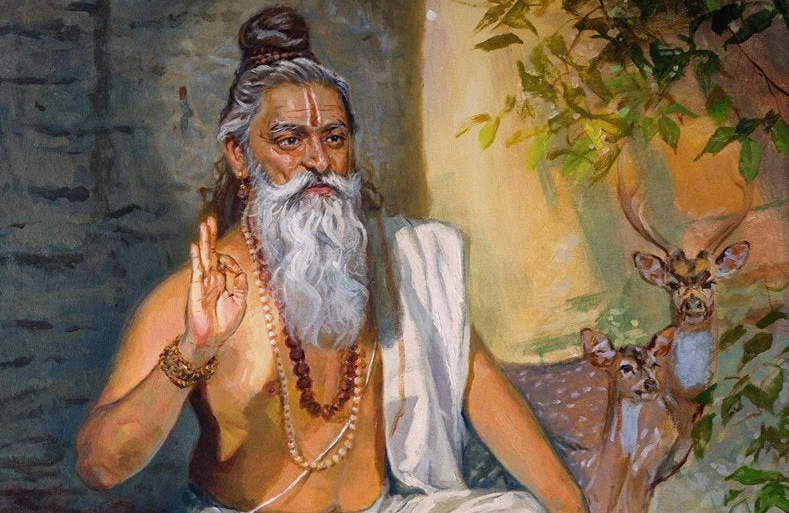
- Guru of Lord Rama.
- Possessor of Kamadhenu, the divine cow that fulfills all wishes.
- His teachings emphasize inner strength, dharma, and spiritual clarity.
Vedic Origins Vashistha (Sanskrit: वसिष्ठ, meaning “most excellent”) is one of the Saptarishis of the current age (Vaivasvata Manvantara). In the Rigveda, he is credited as the chief author of Mandala 7, which contains hymns to Agni, Indra, Varuṇa, and other deities.
His birth is described in two ways: As a mānasaputra (mind-born son) of Lord Brahmā. Or as the son of the deities Mitra and Varuṇa with the celestial nymph Urvashi2. He is married to Arundhatī, a symbol of conjugal devotion, whose star is paired with his in the night sky.
Royal Guru and Statesman Vashistha was the Rājaguru (royal priest) of the Ikṣvāku dynasty, guiding legendary kings like Harishchandra, Dilīpa, and Lord Rāma. He upheld dharma in governance, advising rulers to balance justice, compassion, and truth. His hermitage (Vashistha Ashram) was a great center of Vedic learning, where princes and sages alike studied philosophy, statecraft, and spiritual discipline.
Kamadhenu and the Rivalry with Vishwamitra Vashistha possessed Kāmadhenu (or her daughter Nandinī), the wish-fulfilling cow, gifted by the gods. When King Vishwamitra (then a Kshatriya) tried to seize her, Vashistha used his spiritual power to protect her, defeating Vishwamitra’s army without weapons. This humiliation spurred Vishwamitra to undertake intense penance, eventually becoming a Brahmarishi himself. Their rivalry — and eventual mutual respect — is one of the most famous sagely duels in Hindu lore, symbolizing the triumph of spiritual strength over material might.
Role in the Rāmāyaṇa As the guru of Rāma and his brothers, Vashistha shaped their understanding of dharma and righteous kingship. He advised Rāma during times of moral crisis, reinforcing the path of truth and duty. In the Bāla Kāṇḍa, he narrates the story of King Harishchandra to illustrate the power of truth.
Philosophical Contributions Yoga Vashistha – A profound philosophical text in the form of a dialogue between Vashistha and Rāma, exploring the nature of reality, mind, and liberation. Vashistha Samhita – A text on Vedic rituals and dharma.
His teachings emphasize: The unity of the Self with the Absolute. The illusory nature of the world (Māyā). Liberation (Mokṣa) through self-knowledge and detachment.
Legacy Vashistha is remembered as: A Brahmarishi — the highest rank of sagehood. A symbol of wisdom, patience, and spiritual authority. The eternal companion of Arundhatī, representing the ideal marriage in Hindu tradition. His gotra (Vashistha gotra) is one of the most respected Brahmin lineages. His star (Vashistha) in the constellation Ursa Major is paired with Arundhatī, and newlyweds in Hindu tradition are often shown this pair as a blessing for marital harmony.
7. Vishwāmitra – The King Who Became a Brahmarishi
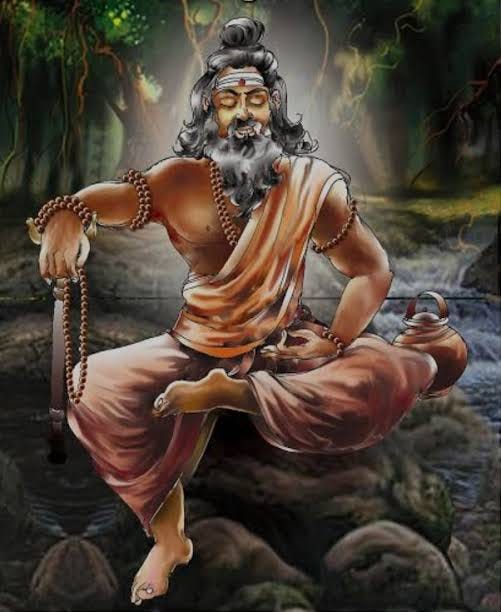
- Once a powerful king, he renounced power to become a sage.
- Composer of the Gayatri Mantra, one of the most sacred Vedic hymns.
- His journey from ego to enlightenment is a profound tale of transformation.
Royal Birth and Early Life Born as Kaushika, a prince of the Lunar dynasty, Vishwāmitra was the son of King Gādhi and a descendant of the great King Kusha. He inherited the throne of Kanyakubja (modern-day Kannauj) and was famed as a valiant warrior, skilled in statecraft and arms. His name Vishwāmitra means “friend of the world” — a destiny he would fulfill in a way no one could have foreseen.
Encounter with Sage Vashistha While on a royal expedition, Kaushika visited the hermitage of Sage Vashistha. Vashistha welcomed the king and his army with lavish hospitality, all provided by Kāmadhenu, the wish-fulfilling cow. Amazed, Kaushika desired the cow for his kingdom, believing it would serve his people. When Vashistha refused, Kaushika tried to seize her by force — but the sage’s spiritual power defeated the king’s army effortlessly. Humbled and awed, Kaushika realized that spiritual power surpassed royal might. This was the turning point of his life.
Renunciation and Tapas Determined to gain the same spiritual strength, Kaushika renounced his throne and began intense austerities (tapas). His goal: to become a Brahmarishi, the highest rank of sagehood — a title Vashistha himself held.
Vishwāmitra’s journey was long and filled with trials: Ego and Anger – He struggled to master his temper and pride. Temptation – The celestial nymph Menakā was sent by Indra to distract him; their union produced the daughter Shakuntalā (later mother of Emperor Bharata). Tests of Compassion – He saved the life of the boy Shunahshepa, offering him refuge and teaching him mantras to escape a human sacrifice.
Protector of Dharma In the Rāmāyaṇa, Vishwāmitra plays a pivotal role in Rāma’s youth: He sought Rāma and Lakṣmaṇa’s help to protect his yajña (sacrifice) from demons like Mārīcha and Subāhu. He initiated them into divine astras (celestial weapons), preparing Rāma for his future battles. He guided them to Mithilā, where Rāma won Sītā’s hand by stringing and breaking Lord Śiva’s bow.
Attainment of Brahmarishi Status After countless years of penance, self-restraint, and service to humanity, Vishwāmitra finally shed his ego. Sage Vashistha, once his rival, acknowledged him as a Brahmarishi — the ultimate recognition of his spiritual attainment. This reconciliation symbolized the union of kṣātra (warrior power) and brahma (spiritual wisdom).
Contributions Gayatri Mantra – Tradition credits Vishwāmitra as the seer (ṛṣi) of the sacred Gāyatrī Mantra (Rigveda 3.62.10), one of Hinduism’s most revered prayers. Rigvedic Hymns – He is the chief author of Mandala 3 of the Rigveda. Model of Transformation – His life is a parable of how determination, humility, and discipline can transform even a king into a sage.Legacy Vishwāmitra’s story is one of the most inspiring in Hindu thought: He began as a proud monarch, driven by rivalry. He endured temptation, hardship, and repeated failure. He emerged as a sage whose compassion, wisdom, and spiritual power served the entire world. Even today, his name is invoked as a reminder that true greatness lies not in birth or power, but in self-mastery and service to all beings.
Their Role in Shaping Dharma
The Saptarishis are more than spiritual guides—they are living archetypes of transformation, humility, and divine service. Through their lives, they:
- Composed and preserved the Vedas
- Established the Gotra system among Brahmins
- Guided avatars like Rama and Parashurama
- Balanced the forces of creation, destruction, and preservation
They reside in Mahar Loka, a realm beyond the mortal plane, and return to Earth whenever dharma falters.

Leave a Reply