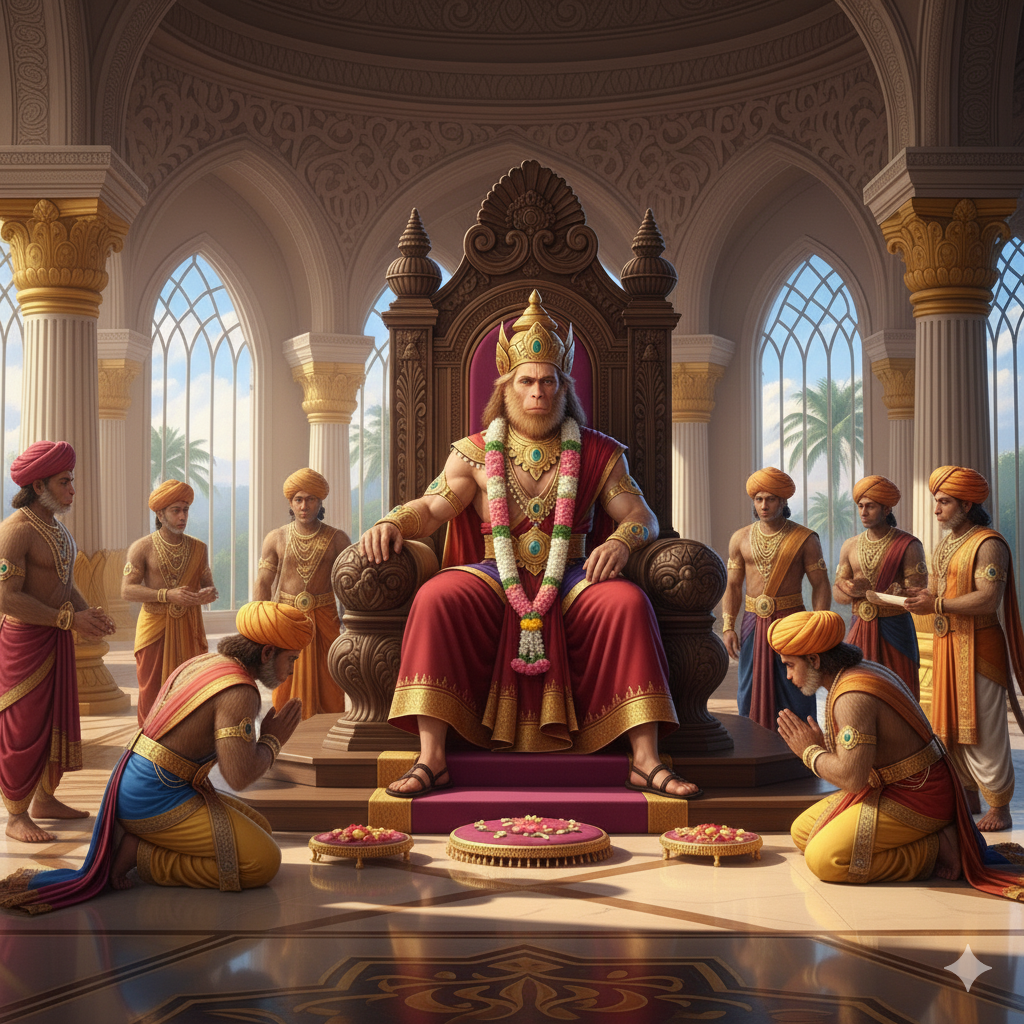
The Story of Dhruva’s Unshakable Devotion
Long ago, there lived a mighty king named Uttānapāda, who had two wives – Suruchi and Sunīti. Suruchi was the king’s favorite, while Sunīti, though noble and gentle, was often neglected.
From Sunīti was born a boy named Dhruva, a child with pure heart and radiant spirit. Suruchi too had a son, and the king loved him dearly.
One day, little Dhruva saw his stepbrother sitting on his father’s lap. With innocent longing, Dhruva too tried to climb onto the king’s lap. But before he could, Suruchi stopped him harshly. With sharp words she said: “Only my son has the right to sit on the king’s lap. If you desire such honor, you must first please Lord Vishnu and be reborn through me.”
The words pierced Dhruva’s heart like arrows. He ran to his mother Sunīti, tears streaming down his face. Sunīti, with love and wisdom, comforted him: “My child, sorrow and joy are fruits of our past karma. If you seek true refuge, turn to Lord Vishnu, the protector oThese words ignited a fire of determination in the young boy. Though only five years old, Dhruva left the palace and journeyed into the forest, resolved to seek Lord Vishnu.
Dhruva’s Tapasya In the forest, the great sage Nārada appeared before Dhruva. Seeing the boy’s unwavering spirit, Nārada tested him with gentle discouragement. But Dhruva stood firm: “O revered one, I do not seek playthings or comforts. I seek only Lord Vishnu’s darshan.” Amazed, Nārada gave him a powerful mantra: “Om Namo Bhagavate Vāsudevāya” Dhruva sat in deep meditation, repeating this mantra with complete faith. His tapasya grew stronger day by day:
First month – He ate only fruits and roots. Second month – Only grass and leaves. Third month – Only water. Fourth month – Only air. Fifth month – He stood still, motionless, like a pillar, fully absorbed in meditation. Such was the intensity of his devotion that the entire universe trembled. The gods themselves approached Lord Vishnu, praying to bless the child.
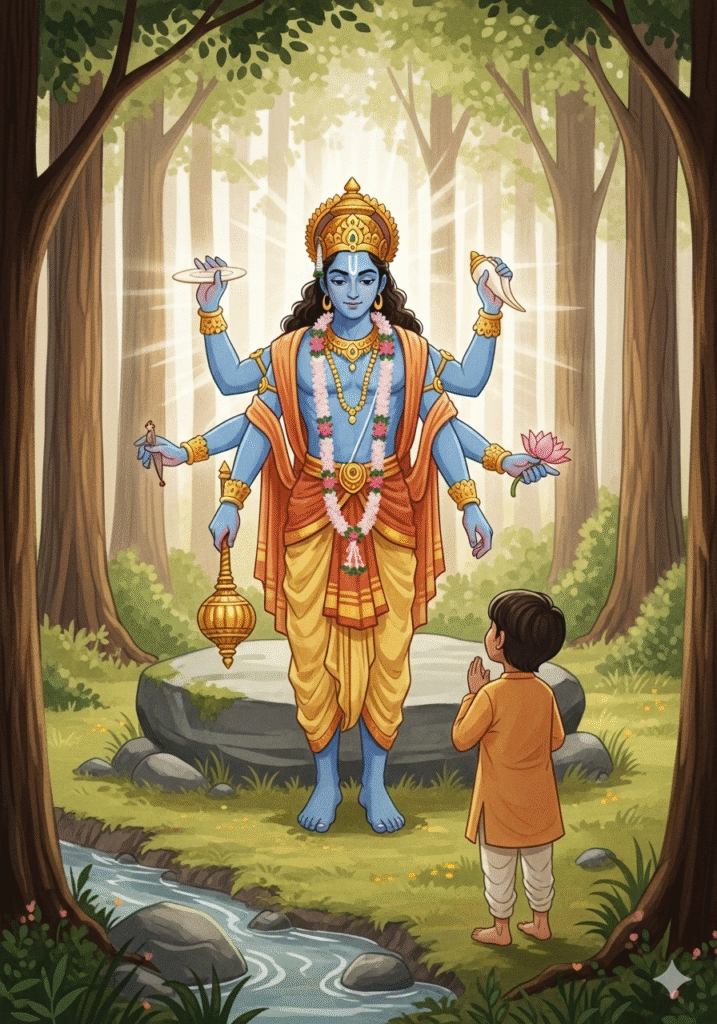
Vishnu’s Blessing Pleased with Dhruva’s unshakable devotion, Lord Vishnu appeared before him, radiant with conch, discus, mace, and lotus in His four hands. Overwhelmed with divine joy, Dhruva bowed down, words failing him. With compassion, Lord Vishnu touched Dhruva’s forehead with His conch, granting him divine wisdom. Dhruva sang hymns of praise that flowed from his heart, blessed by the Lord Himself.
Vishnu then said: “O Dhruva, your devotion is steadfast like no other. You shall rule your father’s kingdom with glory, and after your time on earth, you will attain a place eternal in the heavens. You shall shine as the Dhruva Nakshatra, the Pole Star, guiding generations forever.”
The Eternal Star Thus, little Dhruva, through determination and devotion, attained immortality. Even today, when we look up at the night sky, the Pole Star – Dhruva Tara – reminds us of his unshakable faith.
Moral of the Story True devotion has no age – even a child with pure faith can move the Divine. Insults and hardships can become the doorway to higher spiritual growth. Unwavering determination (Dhruva means firm, fixed) leads to eternal success.
Samudra Manthan – The Churning of the Ocean
Long ago, the Devas (gods) and the Asuras (demons) were locked in endless battles. Once, due to a curse by the sage Durvasa, the Devas lost all their strength, wealth, and radiance. Defeated and helpless, they turned to Lord Vishnu for guidance.
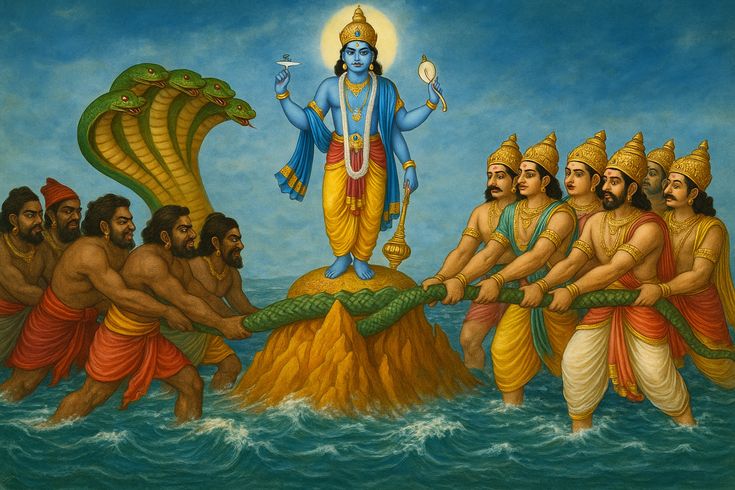
Vishnu, the preserver of the universe, comforted them: “Do not despair. To regain your lost strength, you must churn the ocean of milk – the Kshira Sagara. From it will arise treasures, medicines, and the nectar of immortality, Amrita. But remember, this task is beyond the Devas alone. You must join hands with the Asuras.” Though bitter rivals, the Devas agreed. A truce was formed with the Asuras under Vishnu’s supervision. Thus began the great Samudra Manthan – the Churning of the Ocean.
The Churning Begins For the churning rod, the mighty mountain Mandara was chosen. But when placed into the ocean, the mountain sank into the depths. Seeing their struggle, Lord Vishnu took the form of Kurma, the divine tortoise, and supported the mountain on His vast shell. For the churning rope, they used Vasuki, the king of serpents. The Devas held the tail, while the Asuras took the head. As the churning began, Vasuki’s breath released poisonous fumes, scorching the Asuras. Yet the effort continued, shaking the three worlds.
The Emergence of Halahala From the depths of the ocean first arose a deadly poison – Halahala – so toxic that it threatened to destroy all creation. The Devas and Asuras were terrified, and rushed to Lord Shiva for help. With infinite compassion, Shiva drank the poison, holding it in his throat. His consort Parvati gently pressed his throat, ensuring it did not descend into his body. The poison turned Shiva’s neck blue, giving Him the name Neelkantha – the Blue-Throated One. The universe was saved, and the churning continued.
Treasures of the Ocean One by one, wondrous treasures emerged from the ocean: Kamadhenu, the wish-fulfilling cow Airavata, the white elephant, later taken by Indra Uchhaishrava, the celestial horse Kalpavriksha, the wish-fulfilling tree Apsaras, heavenly maidens of beauty Lakshmi Devi, the goddess of wealth and fortune, who chose Vishnu as her consort Varuni, goddess of wine Kaustubha Mani, the divine jewel adorning Vishnu’s chest And finally, from the depths, arose the long-awaited pot of Amrita, carried by Dhanvantari, the celestial physician.
The Struggle for Amrita The moment the nectar appeared, greed overtook the Asuras. They snatched the pot, refusing to share. The Devas again prayed to Vishnu for rescue. In His enchanting form as Mohini, the divine enchantress, Vishnu appeared. Her beauty captivated the Asuras, who willingly handed over the pot. Cleverly, Mohini distributed the nectar only among the Devas. However, one Asura named Rahu disguised himself as a Deva and drank the nectar. But before it could pass his throat, Mohini cut off his head with the Sudarshana Chakra. His head, immortal, became Rahu, and his body became Ketu, the shadow planets.
The Balance Restored Strength restored by Amrita, the Devas regained their glory. Order and balance returned to the universe. The Samudra Manthan was not merely a struggle for nectar – it was a cosmic drama teaching that cooperation, patience, and divine grace can bring forth treasures from the depths of turmoil.
Symbolism & Moral The ocean represents the human mind, deep and filled with both poison and nectar. The mountain represents steadiness, the rope symbolizes effort, and Kurma (tortoise) stands for divine support. The emergence of poison reminds us that before attaining wisdom and bliss, we must face inner negativity. Only with perseverance, unity, and devotion, can one attain the nectar of immortality – the realization of the Self.
The Birth of Ganga on Earth
In ancient times, King Sagara of the Ikshvaku dynasty performed the great Ashwamedha Yajna (horse sacrifice) to expand his glory. But Indra, the king of heavens, jealous of Sagara’s power, stole the sacrificial horse and hid it deep in the hermitage of Sage Kapila.
Sagara sent his 60,000 sons to search for the horse. Their search ended at the sage’s hermitage, where the horse stood quietly. Mistaking Kapila for a thief, they insulted him in anger. The sage, disturbed in his meditation, opened his eyes, and by his fiery gaze, reduced them all to ashes. The souls of Sagara’s sons wandered restlessly, denied liberation, until the sacred waters of Mother Ganga would descend upon earth and purify them.
Bhagiratha’s Tapasya Generations passed, until King Bhagiratha, a descendant of Sagara, resolved to redeem his ancestors. He left his royal comforts and performed intense penance for thousands of years, seeking the grace of Lord Brahma. Moved by Bhagiratha’s devotion, Brahma appeared and blessed him: “Bhagiratha, your prayers are answered. I shall send Ganga to earth. But beware, her mighty descent will shatter the earth. Only Lord Shiva can contain her force.” Bhagiratha now turned to Lord Shiva, worshipping Him with deep austerity. Shiva, pleased with his devotion, agreed to bear Ganga upon His matted locks.
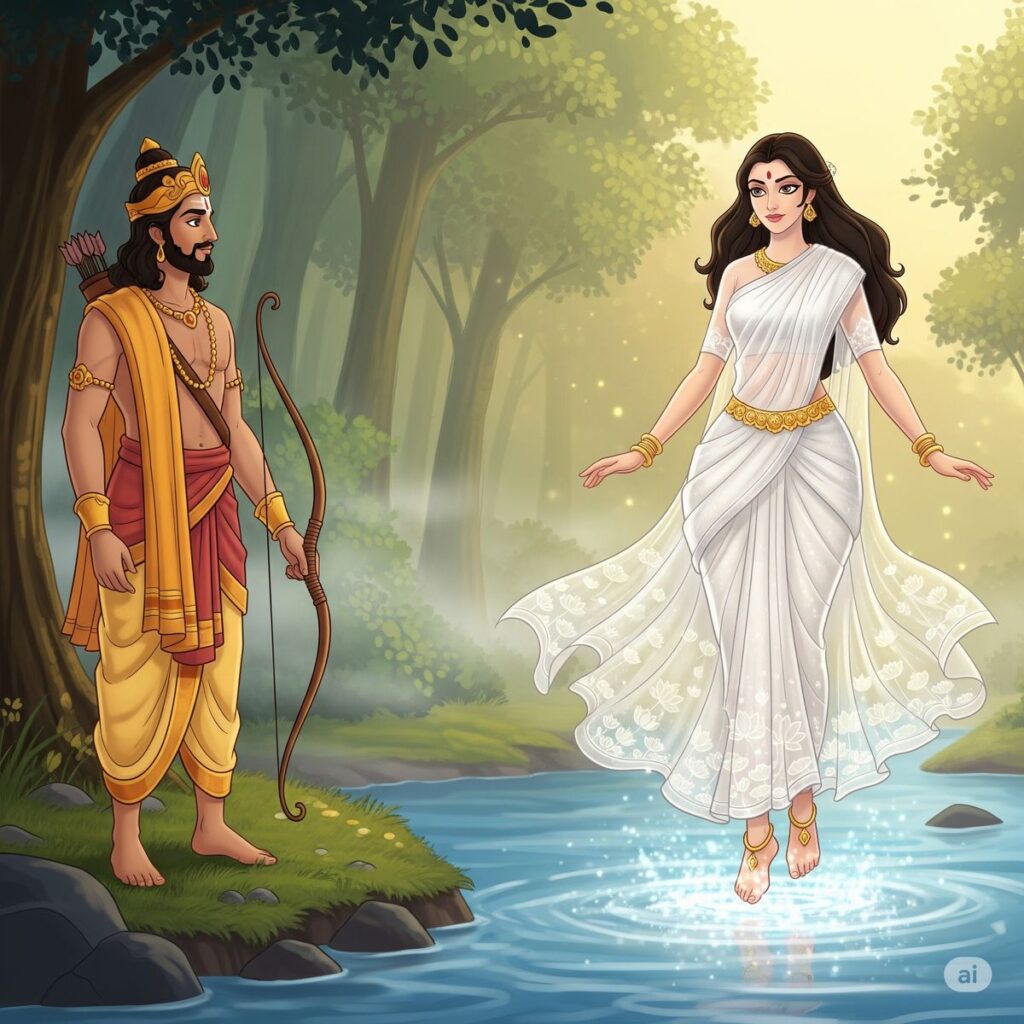
The Descent of Ganga At last, the heavenly river Ganga prepared to descend. With pride and playfulness, she thought to sweep away the earth with her power. But Lord Shiva, knowing her arrogance, caught her in His jata (matted hair), holding her captive in countless strands.For years, Ganga remained trapped, unable to flow. Again Bhagiratha prayed with humility. Pleased, Shiva released her gently in streams, letting her flow gracefully upon the earth.Bhagiratha led her path across mountains, valleys, and forests until she reached the ashes of Sagara’s sons. The holy waters of Ganga touched them, granting them liberation and peace.
Symbolism of Ganga Bhagiratha’s determination gave birth to the phrase Bhagiratha Prayatna – meaning tireless effort to achieve the impossible. Ganga’s descent is the symbol of divine grace flowing into human life, cleansing sins and granting liberation. Shiva’s role teaches that even the greatest forces need control and balance.To this day, Ganga is revered as Mother Ganga, purifier of souls and giver of life.
Moral of the Story Unshakable effort and devotion can move the Divine.True grace comes only when power is balanced with humility.The sacred river reminds us of purity, compassion, and liberation.
Thus, the birth of Ganga on Earth is not only the story of a river, but a tale of penance, humility, and divine blessing, flowing eternally in the hearts of devotees.
The Narasimha Avatar – Destroyer of Ego
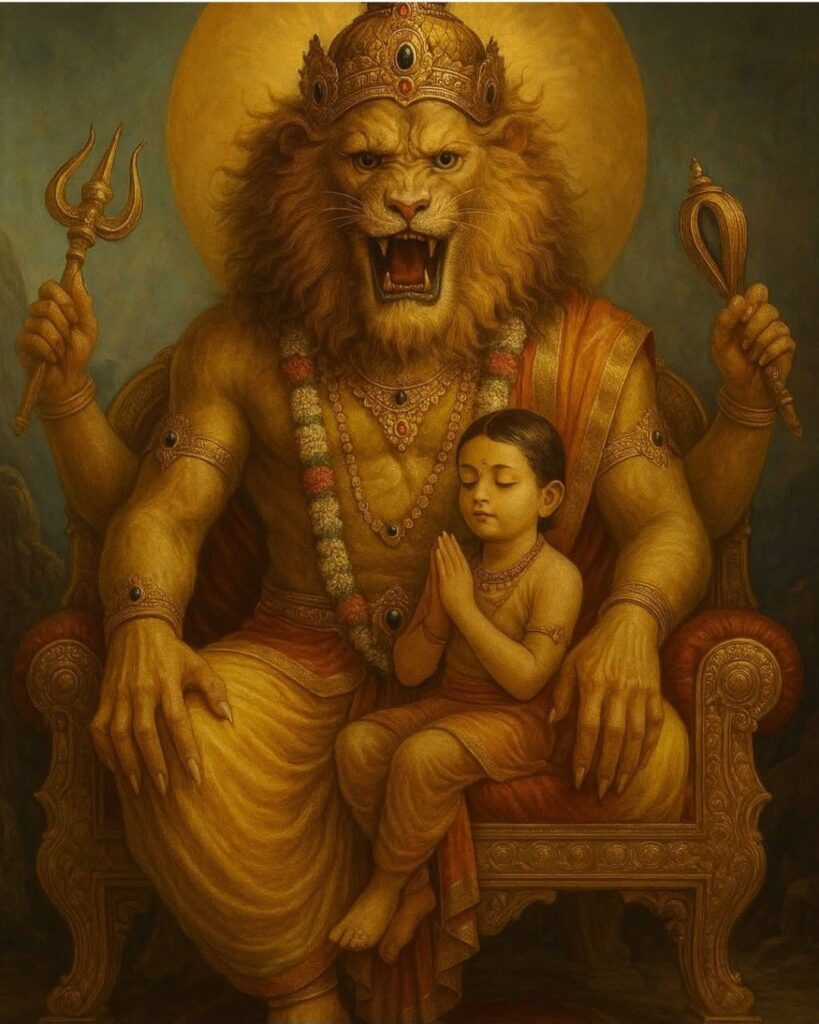
Long ago, in the Satya Yuga, there lived a mighty demon king named Hiranyakashipu. Through intense penance, he pleased Lord Brahma and received a boon that seemed to make him invincible:
He could not be killed by man or beast. Not by day nor night. Not indoors nor outdoors. Not on earth nor in the sky. Not by any weapon of steel or stone. Drunk with power, Hiranyakashipu declared himself the supreme lord of the universe. He forbade the worship of Vishnu and demanded that all beings bow only to him.
Prahlada’s Unshakable Devotion But destiny had a different plan. Hiranyakashipu’s own son, Prahlada, was a devout follower of Lord Vishnu. From childhood, Prahlada’s heart resonated with the divine name: “Om Namo Bhagavate Vāsudevāya” No matter how much his father threatened, punished, or tempted him, Prahlada’s devotion remained unshaken. He endured fire, poison, wild elephants, and swords — yet emerged unharmed by the grace of Vishnu. Hiranyakashipu’s anger grew unbearable. Finally, one evening, he confronted Prahlada in the palace. “Where is your Lord Vishnu? If He is everywhere, is He in this pillar too?” With fury, he struck the pillar with his mace.
The Emergence of Narasimha From the pillar burst forth a terrifying yet divine form — Narasimha, half-man, half-lion, blazing with cosmic energy. Neither man nor beast, neither god nor demon, He roared with uncontainable power. Seizing Hiranyakashipu, Narasimha carried him to the threshold of the courtyard — neither indoors nor outdoors. It was twilight — neither day nor night. Placing the demon on His lap — neither earth nor sky — Narasimha tore him apart with His claws — not weapons of steel or stone. The boon was broken, and the tyrant was destroyed.
Prahlada Blessed After slaying Hiranyakashipu, Narasimha’s anger raged on, shaking the worlds. Only Prahlada’s innocent prayers calmed Him. With tender love, Narasimha placed His hand on Prahlada’s head, blessing him with wisdom, strength, and eternal devotion.
Symbolism of Narasimha Hiranyakashipu represents ego, pride, and denial of the Divine. Prahlada represents faith, surrender, and the power of devotion. Narasimha’s form shows that when adharma grows uncontrollable, the Divine manifests beyond human imagination to restore balance. The story teaches us that no power, no boon, and no ego can stand against truth and devotion.
Moral of the Story Ego is the greatest enemy; devotion is the greatest strength. God protects true devotees, no matter how dire the situation. The Divine always finds a way that surpasses human logic to destroy evil. The Narasimha Avatar thus stands as an eternal reminder: when ego rises unchecked, the Divine roars forth to shatter it, and to protect the humble hearts that live in faith.
The Story of Jayanta, the Son of Indra, as a Crow
During the fourteen-year exile of Lord Rama, his wife Sita, and brother Lakshmana, an important and intriguing episode is recorded in the Ramayana and the Ramcharitmanas. Jayanta, the son of Indra—the king of the gods—became suspicious of Lord Rama’s divinity and wished to test his power.
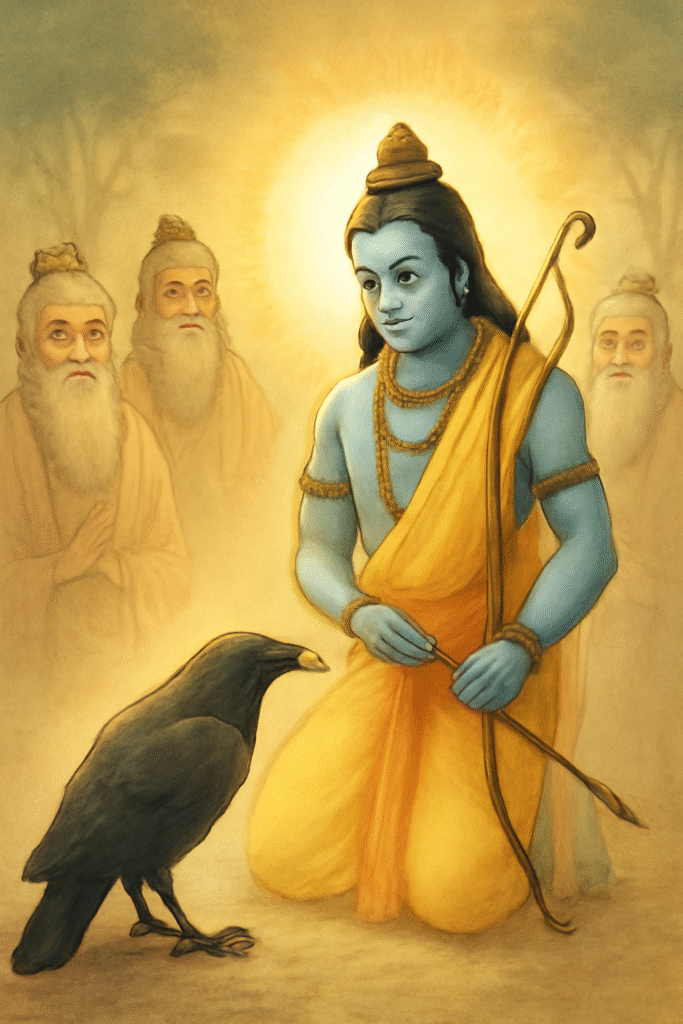
Disguising himself as a large crow, Jayanta flew to the place where Rama was resting on the lap of Sita. While Rama was asleep, the crow attacked Sita, pecking her twice on her feet. In some versions of the story, the crow pecks between her breasts, but the Ramcharitmanas specifically replaces the breast with the feet. The sudden pain alarmed Sita, and hurriedly she tried to fix her loose garment, but in her haste, she ended up loosening it further. This disturbance awakened Rama. He immediately noticed the crow, whose claws were dripping with blood. Recognizing the bird as Jayanta, the son of Indra, Rama was enraged. Upon the request of Sita, Rama took a blade of grass, imbued it with a powerful incantation, and transformed it into the divine weapon known as the Brahmastra. Rama unleashed the Brahmastra on Jayanta, who fled in terror across the universe. The Brahmastra pursued relentlessly, and Jayanta sought refuge with the gods—Indra, Brahma, Shiva, and various sages—but none dared to shelter him, perceiving him as the enemy of Lord Rama. Exhausted and fearful of his fate, Jayanta finally returned and prostrated himself at the feet of Lord Rama, pleading for mercy. “Forgive me, O gracious Lord of the Raghu lineage. I was blinded by doubt and arrogance. Spare me, I beseech you.” Lord Rama compassionately replied, “The Brahmastra, once launched, cannot be withdrawn.” Understanding this, Jayanta begged, “Then please let it strike only my right eye.” Rama granted this mercy, and the Brahmastra hit Jayanta’s right eye, leaving him half-blind. From that day forward, Jayanta continued his existence as a crow with one eye half-blind. The story explains why crows have squinted or partially closed eyes and associates Jayanta with the crow, which is considered an intelligent and somewhat mystical bird in Hindu tradition. The story of Jayanta appears prominently in the Sundara Kanda of the Ramayana and is further elaborated in Tulsidas’s Ramcharitmanas, where the depiction of the crow pecking at Sita’s feet differs from other versions that mention the chest. The use of Brahmastra, a divine celestial weapon capable of immense destruction, emphasizes Rama’s greatness and divine authority. The episode symbolizes themes of doubt, testing of the divine, repentance, and mercy.
Moral of the Story This tale teaches the importance of humility and the danger of arrogance. Even divine beings can err, but sincere repentance and acceptance of justice lead to forgiveness and restoration. It also highlights the supreme power of Lord Rama as the protector of dharma.
The Story of Savitri & Satyaban
The story of Savitri and Satyavan is a famous Indian legend from the Mahabharata that celebrates the devotion, intelligence, and determination of a devoted wife who overcomes death itself to save her husband.
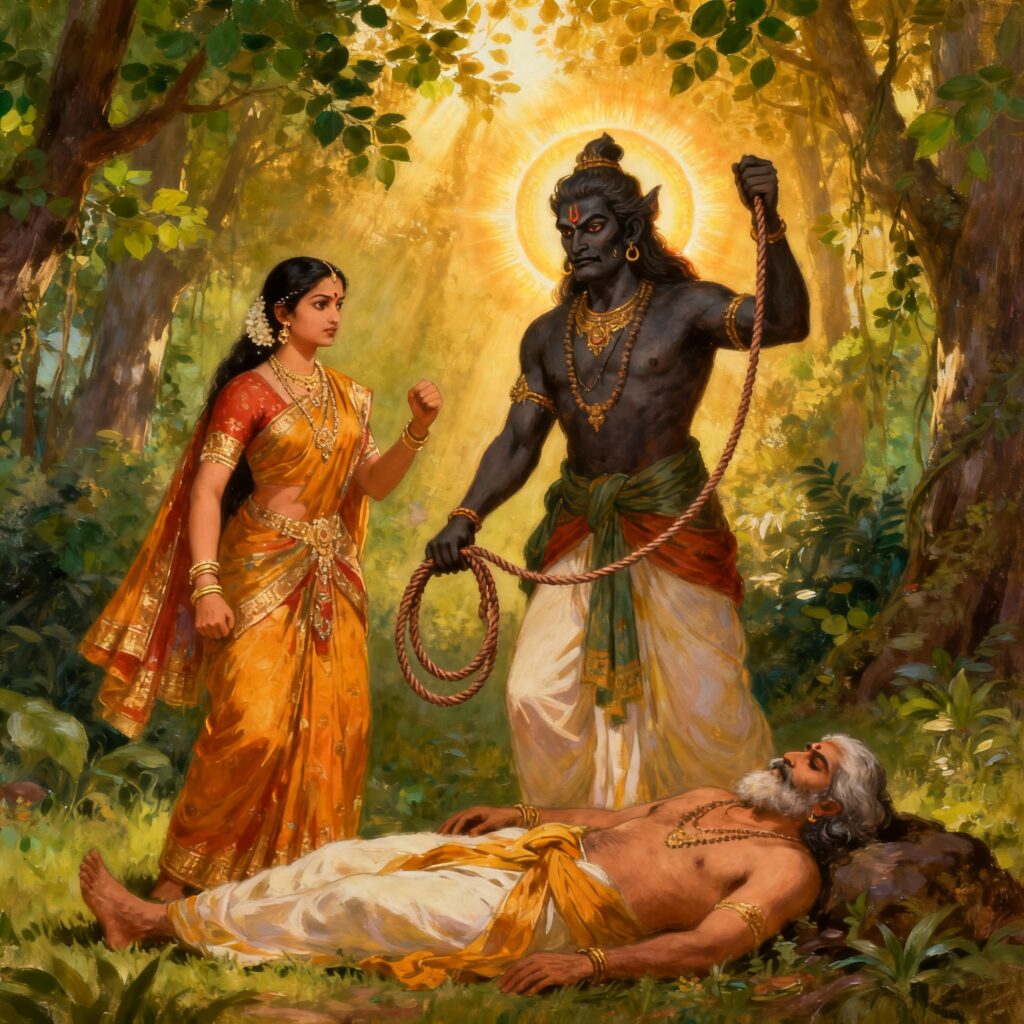
Savitri was a beautiful and virtuous princess, daughter of King Ashvapati of Madra. Despite many suitors, no one dared to marry her because of her exceptional qualities. When Savitri chose Satyavan, an exiled prince living in the forest, as her husband, the sage Narada warned that Satyavan was destined to die within a year. Undeterred, Savitri married him and lived with him and his blind father, Dyumatsena, in the forest. As the fateful day approached, Savitri performed rigorous fasting and prayers. On the day Satyavan was destined to die, he collapsed while cutting wood. Yama, the god of death, appeared to take Satyavan’s soul. But Savitri, with great courage and determination, followed Yama relentlessly, engaging him in conversation and refusing to leave without her husband’s life being spared. Impressed by her devotion, Yama granted Savitri several boons, and through her clever requests, she obtained the restoration of her father-in-law’s sight and kingdom, and ultimately the revival of her husband Satyavan. The couple returned home happily, and Savitri bore a hundred sons, ensuring the continuation of the royal lineage. This story is a symbol of loyalty, love, and the extraordinary strength of a devoted wife who defies fate itself through her purity and steadfastness.
Arjuna’s Dilemma: Lessons at Kurukshetra
At the onset of the great Kurukshetra war, Arjuna, the mighty warrior prince of the Pandavas, asks Lord Krishna, his charioteer, to place their chariot in the middle of the battlefield so he can observe those whom he must fight. To his shock, Arjuna sees his revered elders, beloved teachers, cousins, friends, and relatives arrayed against him. Overwhelmed by sorrow and compassion, Arjuna is seized by a profound moral conflict.
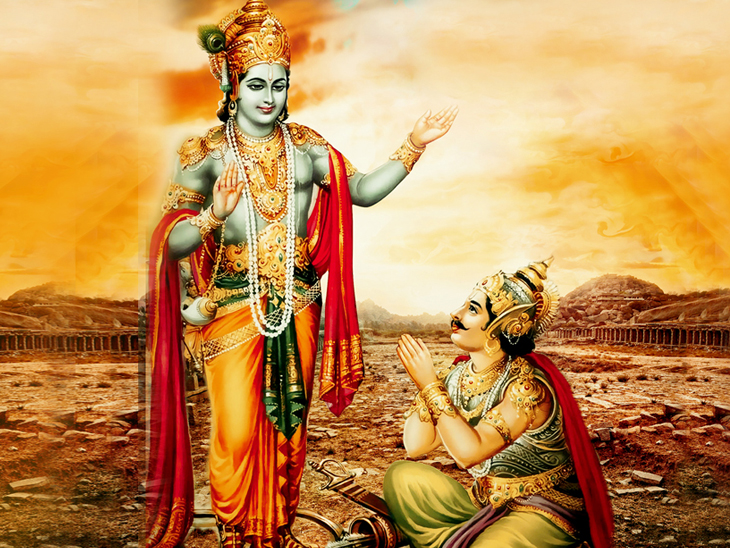
His body trembles, his bow slips from his hand, and his heart is gripped by doubt. He questions the value of victory, kingdom, or even life if it means destroying his own kinsmen and teachers. Arjuna’s mind is torn between his duty (dharma) as a warrior and his love for his family. He fears that killing his family will destroy dharma and unleash chaos. Faced with this moral crisis, Arjuna confides in Krishna and lays down his weapons, surrendering to despair. This inner turmoil leads to the divine discourse of the Bhagavad Gita, where Krishna enlightens Arjuna about the nature of duty, righteousness, immortality of the soul, and the importance of selfless action. Arjuna’s spiritual crisis becomes a universal discussion on moral duty and the path to liberation. On the battlefield of Kurukshetra, as Arjuna is paralyzed with grief and doubt at the prospect of fighting his own family, Krishna offers several profound teachings that form the heart of the Bhagavad Gita. First, Krishna reminds Arjuna about his swadharma—his personal duty as a warrior (Kshatriya). Krishna says, “If you fail to perform your prescribed duty, you will incur sin, and your reputation will be lost. Fighting for righteousness is your sacred responsibility”. He also teaches Arjuna to act without attachment to success or failure: “Do your duty, but do not be attached to the results. Perform actions with a steady mind, for the sake of duty alone” (Karma Yoga). Krishna encourages even-mindedness: “Treat pleasure and pain, gain and loss, victory and defeat with equanimity, and you will not incur sin”. Krishna emphasizes the immortality of the soul (Atma): “The soul is eternal, indestructible, and beyond birth or death. The wise grieve neither for the living nor for the dead. The body perishes, but the soul lives on”. Another vital lesson is renunciation of desire: “Cast aside desires and distractions. Surrender all your actions to me, with knowledge of the divine, and fight—with no claim to rewards”. Krishna assures Arjuna that by acting selflessly for a righteous cause under divine guidance, spiritual liberation (moksha) can be attained even amidst the world’s greatest duties.
These teachings transform Arjuna’s confusion into clarity, empowering him to stand up, reclaim his bow, and fulfill his dharma as a warrior for truth.
Krishna and the Fruit Seller
During his childhood in Gokul, little Krishna hears a fruit seller calling out in the village. Eager to taste her fresh fruits, Krishna gathers a handful of grains to barter. On the way, most grains slip through his tiny fingers, but Krishna, joyful and innocent, runs to the fruit seller with what little he has left.
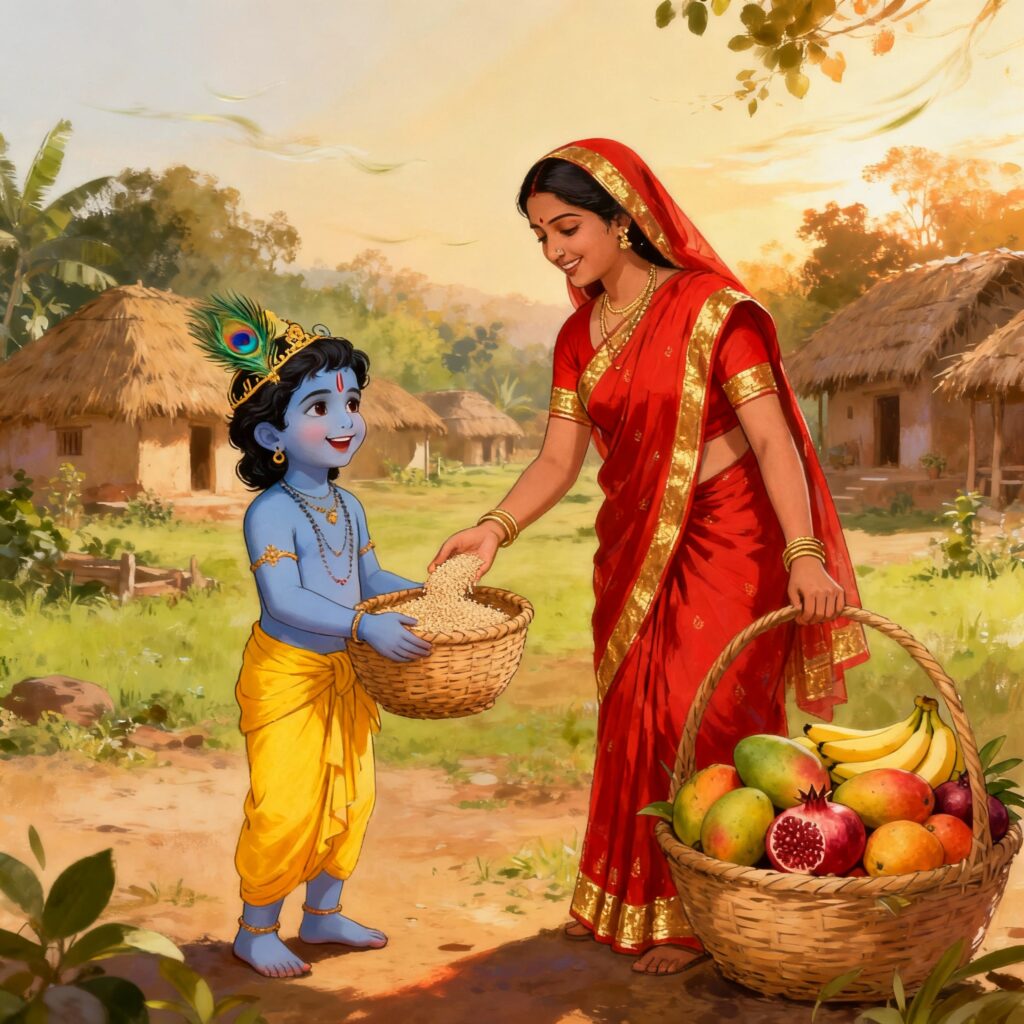
The kind-hearted woman is enchanted by the divine child’s beauty and charm. Delighted, she offers him fruits, accepting the grains with love. In return for her selfless gesture, as Krishna returns home with the fruits, the woman discovers her own basket overflowing with rare gems and gold—a miraculous blessing for her genuine kindness. This story symbolizes the rewards of selfless giving and pure devotion: a small act done with love and faith yields divine abundance and happiness beyond expectations.
Nachiketa and the Secret of Death (Kathopanishad)
The story of Nachiketa and Yama from the Kathopanishad is a profound spiritual tale about a young boy’s quest to understand the deepest mysteries of life and death.
Nachiketa was the son of sage Vājashravas, who was performing a sacrificial ritual that required giving away all his possessions. Observing that his father was giving away only old and weak cows, Nachiketa asked to whom he himself would be given as a gift. Annoyed by the repeated question, Nachiketa’s father said in anger that he would give him to Yama, the God of Death.
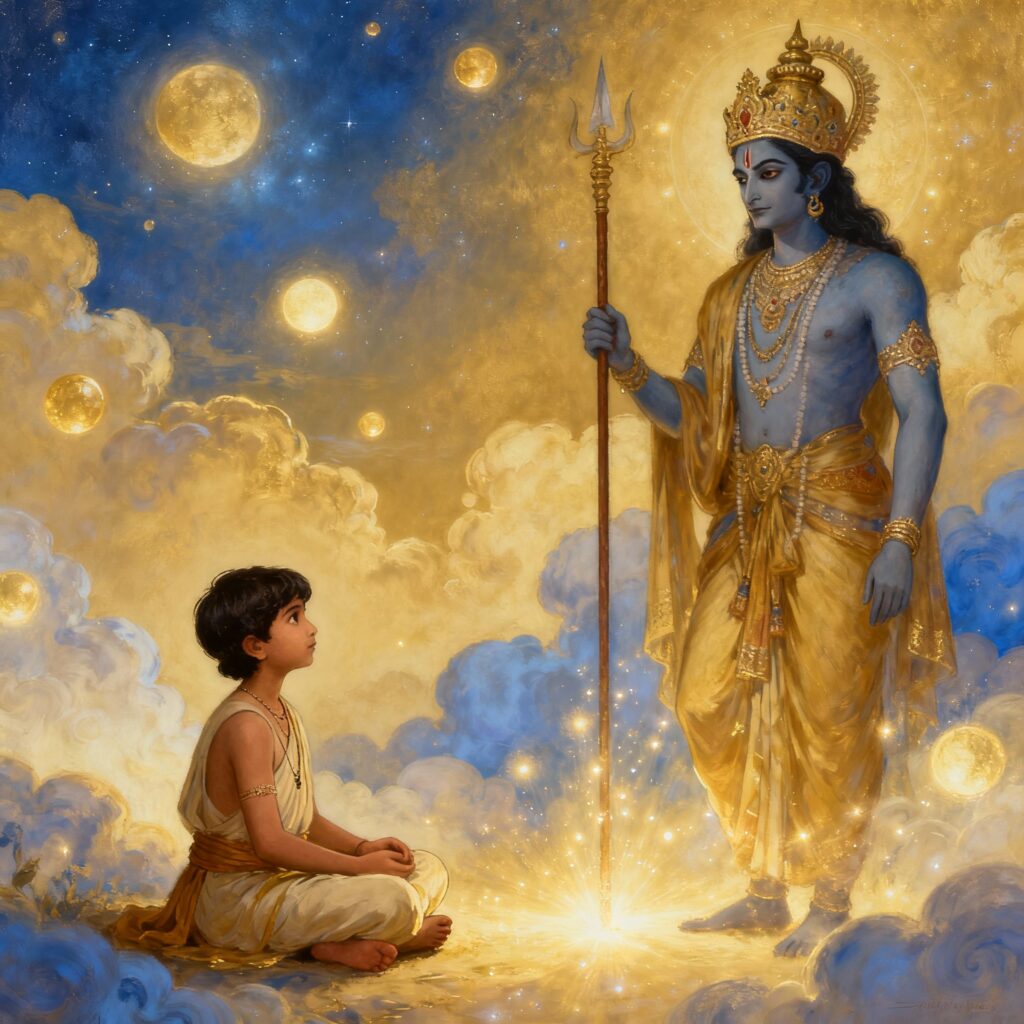
Obedient and fearless, Nachiketa went to Yama’s abode but found the god absent. Undeterred, he patiently waited for three days without food or water. When Yama finally returned, impressed by the boy’s dedication and perseverance, he offered Nachiketa three boons. For the first boon, Nachiketa asked for his father’s peace of mind and that he would not be angry or anxious about him. For the second, he requested knowledge of a sacred fire ritual that could lead to heaven. Yama granted this and taught him the ritual, which later became known as “Nachiketa Agni.” For the third and most profound boon, Nachiketa asked to know what happens after death—what lies beyond life. Yama hesitated and tried to tempt Nachiketa with wealth, long life, and pleasures, but the boy rejected all worldly temptations, insisting on the truth about the soul and immortality. Moved by Nachiketa’s wisdom and determination, Yama revealed timeless spiritual teachings: The soul (Atman) is eternal, beyond birth and death, untouched by worldly changes. Understanding the true Self leads to liberation (moksha), freeing one from the cycle of birth and rebirth. Yama taught that there are two paths in life: the path of pleasure (Preya) which is tempting but temporary, and the path of good (Shreya) which leads to lasting spiritual progress. Thus, the story of Nachiketa encourages seekers to pursue spiritual knowledge with courage and sincerity, rising above fear and desire to realize eternal truth.
Bhasmasura and Shiva’s Cleverness (Shiva Purana)
The story of Bhasmasura from the Shiva Purana is an intriguing tale illustrating the power of blessings and the cleverness needed to wield them wisely.
Bhasmasura was a formidable demon who undertook intense penance to please Lord Shiva, meditating for many years with unwavering devotion. Pleased by his austerity and faith, Shiva appeared before Bhasmasura and offered to grant him any boon he desired. Excited and ambitious, Bhasmasura requested a unique and fearsome gift: the power that anyone whose head he touched with his hand would instantly turn to ashes.
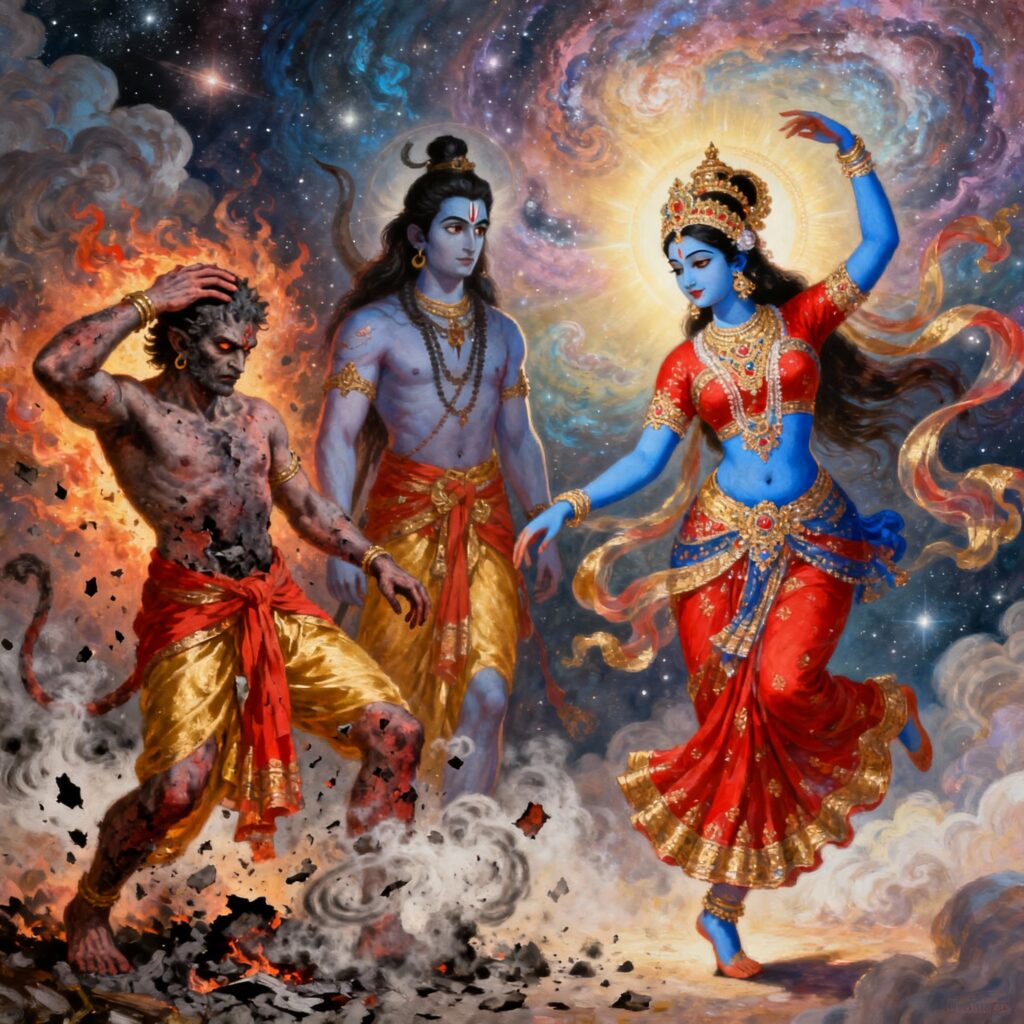
Shiva, bound by his word, granted him this extraordinary boon. However, intoxicated by his newfound power, Bhasmasura became arrogant and dangerous, threatening even Shiva himself. To test the power, Bhasmasura attempted to place his hand on Shiva’s head, intending to reduce him to ashes, forcing Shiva to flee desperately. The situation grew dire as Bhasmasura relentlessly pursued Shiva. Seeing his friend in peril and the potential havoc Bhasmasura could wreak, Lord Vishnu intervened. To save Shiva and maintain cosmic balance, Vishnu transformed into the enchanting Mohini, a mesmerizing female dancer. Mohini’s beauty and graceful dance captivated Bhasmasura, who became completely enamored with her. She challenged him to imitate her dance moves, promising to marry him if he succeeded. Enthralled and vain, Bhasmasura agreed, mirroring her every move. Finally, Mohini placed her hand atop her own head as part of the dance. In his infatuation, Bhasmasura mimicked her, placing his hand on his head. Instantly, the power of his own boon turned against him, and he was burnt to ashes. Thus, using cleverness and divine intervention, the evil Bhasmasura was destroyed, teaching a lesson about the misuse of power and the importance of wisdom and humility. Shiva returned safely, And Vishnu resumed his true form, highlighting the harmony of divine cooperation in protecting dharma.


Leave a Reply to Blog – Spiritual Khazana Cancel reply